Wolf Growth Alternative? What the AI Pitch Leaves Out
.jpg)

Wolf Growth's marketing is built around one word: AI. AI growth agents, AI-powered posting recommendations, "intelligent behavior throttling," a conversation AI for your inbox. It's a genuinely broader feature set than most Instagram growth services offer, bundled into three escalating price points — plus a fourth, $997-a-month Elite tier for businesses that want a dedicated human account manager on top of all that automation. If you've read through that pitch and found yourself searching for a Wolf Growth alternative anyway, it's probably because the marketing raises a fair question it doesn't fully answer: does more automation mean more real growth, or does it just mean more moving parts that could go wrong on your account?
Kicksta answers a narrower question on purpose. It doesn't manage your inbox, repost your content, or run "AI growth agents" — it does one thing, which is engage real, relevant Instagram accounts on your behalf so that real people choose to follow you. That's a smaller pitch than Wolf Growth's, and this comparison is really about whether Wolf Growth's larger bundle of automated features earns its larger price tag, or whether it's mostly surface area for something to go wrong — and about whether either company's results claims hold up when you go looking for specifics.
One Platform, Many Automations Stacked on Top of Each Other
Wolf Growth's three core tiers each add another layer of automated activity running on your account. Wolf Plus, at $99 a month, covers story actions (automatically viewing and reacting to stories from target accounts) plus "smart interactions," polls, and live insights. Wolf Pro, at $149, adds outreach campaigns, automated content reposting, and an inbox assistant that reads and drafts replies to your DMs. Wolf Business, at $199, layers on "AI growth agents" and a content engine. The $997-a-month Elite tier goes further still: hyper-targeted acquisition, micro-influencer outreach, management of up to two accounts, and a senior account manager assigned to your business specifically.
Add it up and by the time you reach Wolf Business, you've got automated story-viewing, automated outreach messaging, automated reposting, an automated inbox, and an "AI agent" layer all running simultaneously on one Instagram account — coordinated by what the company calls "intelligent growth systems" and made to look natural through "randomized interaction delays" and "strict daily limits."
Independent reviewers have picked up on the risk that comes with stacking that much automated behavior in one place. One independent review flagged that Wolf Growth's "Story Viewer method" — automatically viewing large numbers of stories to trigger reciprocal interest — has been cited elsewhere as a violation of Instagram's terms of service, and reported that "some accounts have been banned when using their services, and the users didn't receive any customer support after this." That's worth being precise about: it's one reviewer's account of user reports, not an independently verified pattern across every Wolf Growth customer. But it's exactly the kind of risk that shows up when five different automated behaviors are all touching the same account instead of one.
Kicksta's model has one moving part: targeted engagement from real accounts, visible on Kicksta's growth-analytics dashboard, which tracks follower trends and engagement in real time and runs a weekly AI-driven audit of your content and bio to suggest what to adjust. There's no story-viewing bot, no inbox automation, no separate "agent" layer running in parallel — which also means there's a lot less surface area for any single piece to trip a detection system in a way that's hard to trace back to a cause.
Targeting: A Feature List vs. a Filtering System
Wolf Growth's audience targeting is described as reaching "users interested in specific niches or industries," with progressively more granular audience filters unlocked at the Pro and Business tiers. That's reasonable as a pitch, but the company doesn't publish much about how targeting narrows down to relevant accounts — the language stays at the level of "smart" and "intelligent" rather than naming concrete mechanisms a customer could evaluate before paying for it.
That vagueness isn't unique to Wolf Growth. Stim Social's targeting claims run on the same auto-like, auto-follow, and story-view engine aimed at hashtag, location, and profile targets, and it's just as light on specifics about how those targets get selected — a pattern that shows up whenever a service leans on "intelligent" as a description instead of naming the underlying targeting logic.
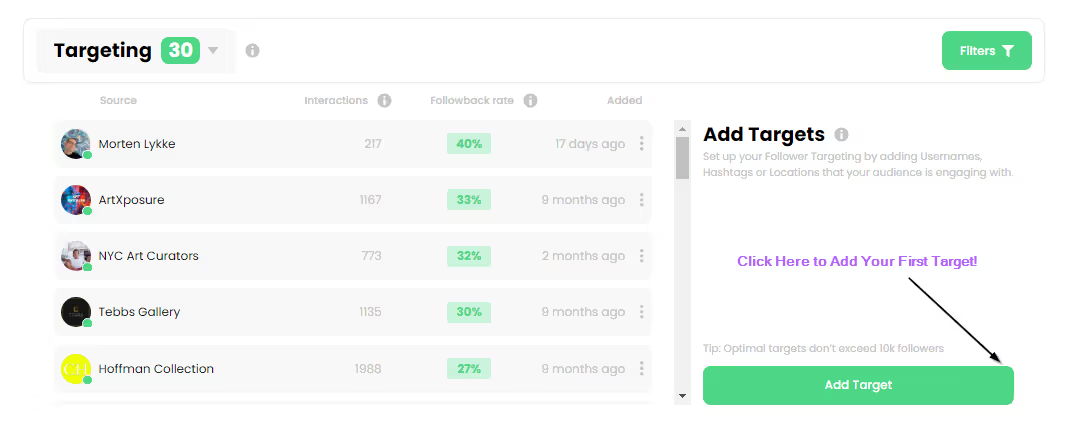
Kicksta's targeting is more specific by design: you name competitor accounts, relevant influencers, and hashtags directly, and the growth-analytics dashboard shows which of those named targets are converting into real engagement, week over week. It's a similar amount of AI-branded language on both sides of this comparison, but Kicksta's version comes with a dashboard that shows its work — you can see which targets produced followers and which didn't, rather than trusting a black-box "smart" label to have picked the right accounts on your behalf.
The Numbers Behind Each Pitch
This is where the comparison gets concrete instead of staying at the level of marketing copy, and it's worth slowing down for. Wolf Growth's Elite tier page features testimonials — real quotes, presumably from real customers — but they read like this: "Every day we see new people, real DMs, and leads that actually match our business perfectly," and "The team gave me smart strategic insights on our audience positioning, and instead of chasing engagement, I'm seeing steady leads." Those are pleasant sentences, and they may well be sincere. Neither one contains a number. There's no follower count, no timeframe, no before-and-after — just a general sense of satisfaction that a reader has no real way to independently size up or compare against their own situation.
Kicksta's own case-studies page takes the opposite approach, and walking through it is the clearest way to see the difference. Kristi Eide, a fitness and lifestyle influencer who works full-time in the software industry, grew her fitness brand from 0 to 10,000 followers in two months using Kicksta — a specific, dated, numeric result a reader can hold up against their own goals and decide if it's realistic for a comparable niche. Sara Louise Wylie's case study cites a jump from 100 to 1,500 followers in about six weeks, a smaller but similarly concrete number for someone starting from close to zero. Todd Pinckney, a photographer and entrepreneur, reports getting 12 high-quality leads from Instagram every month through the platform — a business-outcome figure, not just a follower count, which matters directly here because Wolf Growth's own Elite-tier pitch leans on "leads that actually match our business" as its headline value proposition too, without a single number attached to it. Raindrop Marketing Agency, a San Diego branding and marketing firm, cites saving 15 hours a week by using Kicksta instead of handling growth manually — a time-cost figure that a busy agency owner can convert directly into a dollar value for their own business. And Drew D'Ambrosio's case study points to a cumulative 60,000 followers built through the platform over time.
None of this means Kicksta's results are guaranteed or typical for every account — results vary by niche, starting audience, content quality, and effort, and Kicksta says so directly rather than promising a fixed outcome. But there's a real, structural difference between a testimonial that says "leads that actually match our business" and a case study that says 12 leads a month, every month, from a named photographer whose business is a matter of public record. One is marketing language calibrated to sound good; the other is a claim specific enough that a skeptical reader could go check it.
{{blog-cta-section}}
Safety, Automation Risk, and an Odd Trustpilot Detail
Wolf Growth's safety pitch centers on "randomized interaction delays" and "intelligent behavior throttling" designed to make automated activity look human to Instagram's systems. That's a reasonable engineering goal on its own terms, but it's also, by definition, a description of automated activity trying not to look automated — a different safety proposition than simply not running automated activity that needs disguising in the first place. Instagram's community guidelines prohibit inauthentic engagement regardless of how well it's throttled, and the account-suspension reports mentioned above suggest the throttling doesn't always hold up in practice.
There's also a specific, checkable oddity worth flagging here, the kind of thing this project's own standing practice is to surface rather than carry over silently: Wolf Growth's Trustpilot listing at wolfgrowth.com currently displays under the name "GlassWorld.biz," described as a glass-etching service, with only two reviews on record — both of which describe "Wolfgrowth.com" and a software service that "breaks down all the time," not glass etching at all. That's either a data-quality glitch on Trustpilot's end or a sign this specific listing has changed hands or purpose at some point. Either way, it means Wolf Growth doesn't currently have a clean, easily verifiable independent review history the way some competitors do, which is worth knowing before treating any star rating you see quoted elsewhere as the full picture.
It's not the only Instagram growth service in this project whose AI-heavy marketing pitch has run into a similarly messy Trustpilot situation once you go look. CrowdIgnite's own pitch — patented AI, GPT-5.5, growth in 24 hours — turned out to sit behind a Trustpilot profile whose rating is unavailable because of a guideline breach and a batch of removed fake reviews. In both cases, the AI branding is the most visible thing about the service; the independent evidence backing it up is the part that takes real digging to find, and doesn't hold up as cleanly once you do.
Kicksta's engagement runs through real accounts taking real actions on your behalf — there's no automated behavior to throttle or disguise, because there's no automated behavior happening on your account at all.
Pricing: Escalating Tiers vs. Two Flat Plans
Wolf Growth charges by feature tier: $99, $149, or $199 a month depending on how much automation you want switched on, with the $997-a-month Elite tier reserved for businesses wanting a dedicated account manager and multi-account management. There's no published annual discount at any tier — it's month-to-month, with the option to cancel anytime and no long-term contract.
Kicksta vs. Wolf Growth: Pricing at a Glance
| Plan | Price | What You Get |
|---|---|---|
| Kicksta Growth | $69/mo $49/mo quarterly · $39/mo annual |
Up to 10 sources, competitor & hashtag targeting, Smart niche filters |
| Kicksta Advanced | $129/mo $99/mo quarterly · $79/mo annual |
Up to 30 sources, plus Welcome DM, Close Friends Adder & Gender filter |
| Wolf Plus | $99/mo | Story actions, smart interactions, polls, live insights |
| Wolf Pro | $149/mo | Plus, plus outreach campaigns, content repost, inbox assistant |
| Wolf Business / Elite | $199/mo – $997/mo | AI growth agents, content engine; Elite adds a dedicated account manager |
Kicksta pricing verified live at kicksta.co/pricing. Wolf Growth pricing reflects wolfgrowth.com's published tiers at time of writing.
Kicksta's two plans are simpler by design: pick how many sources you want to target, get every core feature at that tier, done. Even Kicksta's top plan, at $129 a month (or $79 a month billed annually), costs less than Wolf Growth's entry-level Plus tier once you annualize it — and works out to roughly an eighth of Wolf Growth's Elite tier. You're not paying more each time another automated feature gets bolted on; you're paying for more targeted engagement volume, full stop, with the feature set staying identical in almost every respect between the two plans.
From Checkout to First Results
Wolf Growth's onboarding funnels you through a tier-selection decision first — Plus, Pro, Business, or Elite — before you've necessarily had a chance to see which of those automated features you'd use. Checkout at wolfgrowth.com/checkout is straightforward once you've picked a tier, and the company maintains a knowledge base at help.wolfgrowth.com for setup questions afterward.
Kicksta's own tiered-versus-team question shows up elsewhere in this project, too — HypePlanner's higher plans bundle in a dedicated human team the same way Wolf Growth's Elite tier does, for a similar reason: past a certain price point, customers start expecting a person, not just more software. Kicksta doesn't offer that human-account-manager tier at all, on purpose — every plan is the same self-serve engine, just scaled by volume.
Kicksta's setup skips the tier-shopping decision entirely: there's one real choice (Growth or Advanced, based on how many sources you want to target), then a short questionnaire about your target audience, and the 7-day free trial starts showing real engagement activity within the first day or two. Because there's only one thing happening — targeted engagement, not five stacked automations plus an inbox bot — there's less to configure and less to second-guess before you commit a card number.
Where Wolf Growth Fits, Realistically
If what you want is one subscription that replaces several separate tools — story engagement, an inbox assistant, content reposting, and audience polls, all under one login, with the option to add a human account manager at the top tier — Wolf Growth's higher plans are built for exactly that kind of consolidation, and for a business already paying for three or four point solutions separately, that bundling could plausibly be worth the premium even with the automation risks noted above. That's a real, specific use case, not a hypothetical one. It's just a different job than what most people searching for "Instagram growth" are actually trying to solve, which is building a following that sticks around and converts — not managing an operations dashboard with more moving parts than they started with.
Two Things Worth Deciding Before You Sign Up
Are you trying to replace several separate social media tools with one subscription, and are you comfortable with more automated activity running on your account to get that consolidation? Wolf Growth's Pro and Business tiers are built around exactly that trade.
Do you want your Instagram following to grow every month through real engagement with real accounts, backed by results you can actually check rather than testimonial quotes? That's what Kicksta is built for, and it's the more common reason people end up on this particular comparison.
The Gap Between the Two Pitches
Wolf Growth's pitch is broader than Kicksta's — more automated features, more tiers, a premium option with a human account manager attached. But breadth isn't the same as reliability, and the specifics here matter: an independent review flagging a terms-of-service risk in one of Wolf Growth's automation methods, user reports of account bans with no customer-support follow-up, and a Trustpilot listing that currently doesn't even display the right company name. Kicksta's pitch is narrower, and its evidence is more specific — named customers, dated results, a monthly lead-generation figure you can measure directly against Wolf Growth's own unquantified lead-gen testimonial. For most people comparing these two services, the deciding factor isn't which one promises more features; it's which one's claims you can actually go check for yourself.
Wolf Growth FAQ, Minus the Marketing Spin
Is Wolf Growth legit? It's an operating company selling a real product, not a disappearing-act scam. The more relevant question is whether its automated methods are safe and effective, and the evidence there is mixed — one independent review rated it 2 out of 5 and explicitly recommended against it, citing potential terms-of-service issues and a thin independent review history.
Does Wolf Growth's AI actually work? It runs the automated activities it advertises — story views, engagement interactions, DM outreach, content reposting at higher tiers. Whether that produces engaged, lasting followers or what one reviewer called "inorganic growth" appears to depend heavily on the account and niche; reviewers describe inconsistent results rather than a uniform outcome across customers.
What do Wolf Growth reviews actually say? Independent, unaffiliated reviews are relatively scarce for this service. A separate review found follower quality "uncertain," with some users reporting inactive followers and a drop-off after a few weeks despite fast 24-48 hour delivery. Wolf Growth's Trustpilot listing, as noted above, currently shows under a different company name entirely, which makes it hard to point to a clean, verifiable aggregate rating the way you can for some other services in this space.
How much does Wolf Growth cost? $99 to $199 a month across its three main tiers, with a $997-a-month Elite tier for businesses wanting a dedicated account manager and multi-account management. There's no published annual discount at any level.
What's the actual alternative if I want an agency-scale option with results I can verify? Kicksta runs a dedicated program for marketing agencies managing multiple client accounts, with white-label reporting and per-account billing — the same "handle this at scale" need Wolf Growth's Elite tier is built for, but backed by the same checkable case studies referenced above rather than unquantified testimonials.