SupGrowth Alternative for When "Human-Powered" Isn't Enough
.jpg)
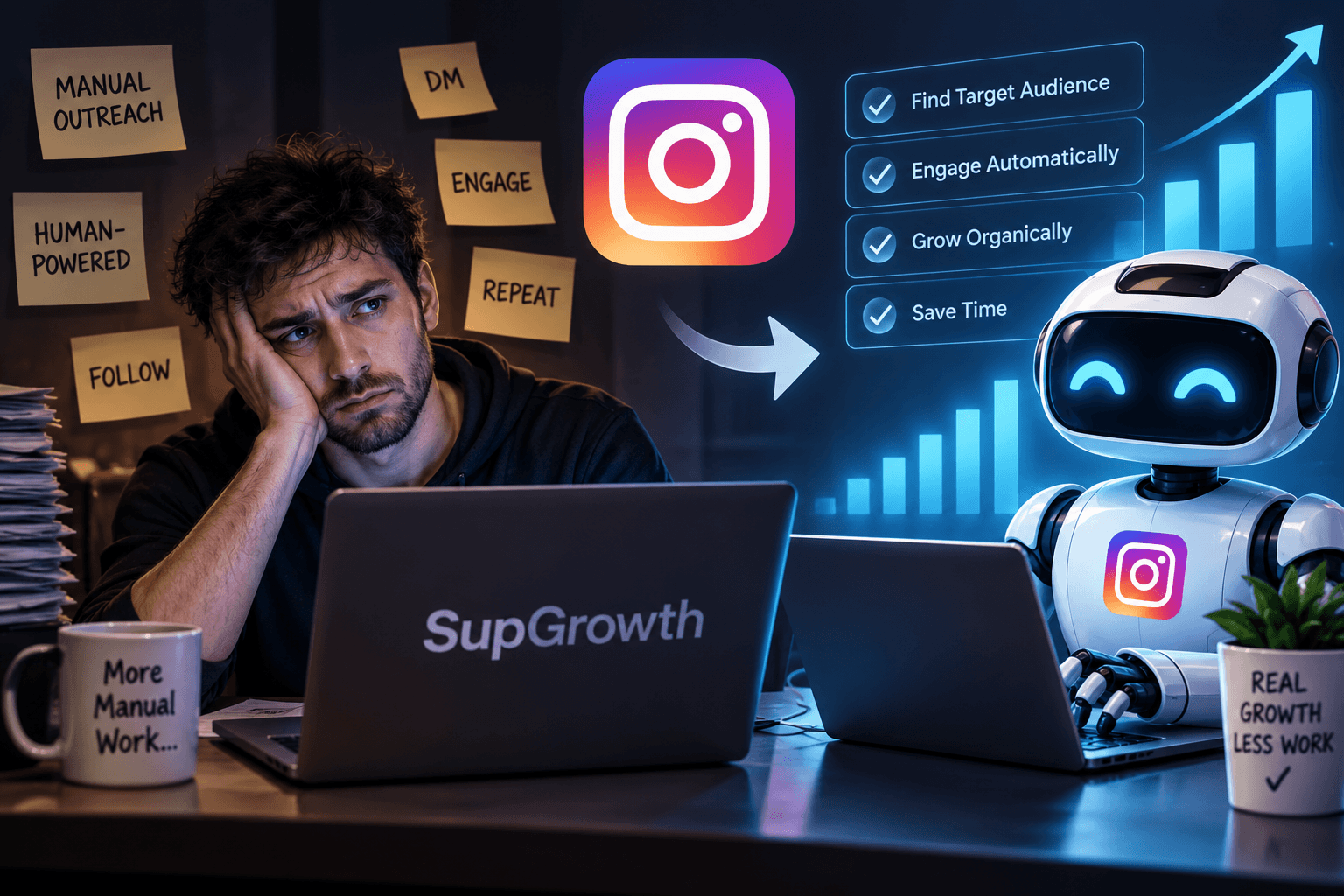
SupGrowth's whole pitch rests on one idea: everything is done by a person, not a bot. No automation, no software, just a dedicated account manager spending real hours a month liking, following, and messaging on your behalf. For anyone who's been burned by an automation-heavy growth service before, that's an appealing story — it sounds safer almost by definition. But "a human did this" and "this is safe, and it worked" turn out to be two different claims, and the more you look at SupGrowth's own numbers and the reviews written about it, the more daylight opens up between them. That gap is probably the real reason someone searches for a SupGrowth alternative: not because manual labor sounds bad, but because it's hard to verify from the outside, and at least one independent reviewer has gone looking and come back with a very different story than the one on SupGrowth's own landing page.
Kicksta takes a different approach to the same problem. It doesn't sell "a person did this by hand" as the safety argument — it sells a dashboard you can check yourself, targeting you configure directly, and published case studies with names and dates attached. This comparison is really about which kind of proof you'd rather have: a company's word that its people are working hard on your behalf, or a set of numbers you can independently verify.
Sixty Hours a Month, Spent on Strangers
SupGrowth's core offering is a single "Growth" plan built around one number: up to 60 hours a month of manual account management, performed by a dedicated account manager during business hours (the company says roughly 11 hours a day, six days a week, specifically so the activity looks natural rather than mechanical). In that time, the manager curates a list of around 10,000 targeted profiles — filtered by niche, location, and competitor-follower lists — and manually follows, likes, and views stories from them, sends welcome DMs to new followers, and deliberately avoids commenting, which the company says is more likely to trip Instagram's spam filters than liking or following is.
That's a different operating model from most services in this space, and it deserves to be taken at face value: a real person, not a script, is clicking those buttons, 60 hours a month, six days a week. But the safety argument built on top of that fact doesn't hold up as cleanly as it sounds. Instagram's own community guidelines prohibit inauthentic engagement patterns — mass following, mass liking, and repetitive outreach aimed at accounts that never asked for contact — regardless of who or what is pressing the button. A human manually working through 10,000 curated profiles a month is still producing the same repetitive, one-directional behavior pattern that automated tools produce; the account doing the following just happens to have a person behind the keyboard instead of a script running the same loop. Whether that distinction changes anything for Instagram's own detection systems is an open question SupGrowth's marketing doesn't really engage with — the pitch treats "manual" and "safe" as though they're the same word.
There's a similar pitch already covered in this project, and it's a useful point of comparison: AscendViral's manual-only model makes almost the identical "real people, not bots" argument, at a different price point and with its own guarantee. The two services differ in the specifics, but the underlying claim — and the underlying question about whether it changes the safety math at all — is the same one.
On the opposite end of that spectrum sits Suparise's fully automated desktop software, which makes no claim to manual labor at all; between the two, SupGrowth's manual-hours pitch and Suparise's software-only pitch bracket a wide range of "who's doing the engagement" stories, and none of the three (including Kicksta) is exempt from the same underlying question — does the specific behavior pattern look natural to Instagram's systems, regardless of who or what produces it.
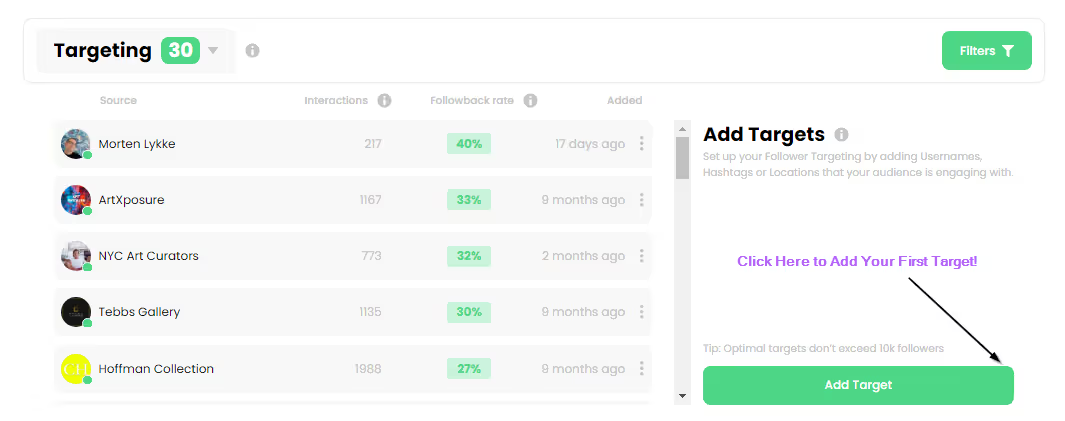
With Kicksta, you name the competitor accounts, hashtags, and influencer profiles you want to target, and Kicksta's growth-analytics dashboard shows which of those targets are converting into real engagement — not a promise that a person is working hard somewhere on your behalf, but a live number you can check today, from your own account, without waiting on a monthly summary email.
Who Gets a DM, and Why
SupGrowth's targeting is described as niche- and location-based, plus competitor-follower lists, all curated by the account manager rather than configured by the customer directly. That's consistent with the manual-labor pitch — a person is doing the curating — but it also means you're trusting someone else's judgment about who counts as a relevant target for your specific account, with no dashboard showing you which of those 10,000 monthly contacts turned into a follower versus which ones just got a story view that went nowhere and never converted.
Kicksta's targeting puts that control in your hands instead: you specify the competitor accounts, hashtags, and influencer audiences directly, and the dashboard breaks each one down separately — a follower count next to every target you've named, updating as new followers come in — so you can redirect effort toward what's converting rather than waiting on a monthly email summarizing 10,000 contacts you never got to see individually. The two companies are both promising relevance; only one of them shows you the receipts as you go, in real time, rather than as a monthly narrative written by the same person doing the outreach.
{{blog-cta-section}}
What Sup Growth's Own Numbers Leave Out
SupGrowth's marketing cites 300 to 900+ new organic followers a month, roughly 2,000+ profile views, and — in aggregate, across its whole customer base — over 910 clients and more than 3.45 million followers gained collectively. Those are large-sounding numbers, and they may well be accurate in aggregate. But none of them are attached to a specific, checkable account. There's no name, no date, no "here's what happened to this one real business" — just a company-wide total a reader has no way to independently size up against their own situation, or verify against any individual customer's own experience.
Kicksta's own case studies take the opposite approach, and walking through a few of them is the clearest way to see the difference. Kristi Eide, a fitness and lifestyle influencer, grew from 0 to 10,000 followers in two months using Kicksta — a specific, dated result tied to one named account, not folded into a company-wide total. Sara Louise Wylie's case study cites a jump from 100 to 1,500 followers in about six weeks. Todd Pinckney, a photographer and entrepreneur, reports 12 high-quality leads from Instagram every month through the platform — a business outcome, not just a follower count. Raindrop Marketing Agency, a San Diego marketing firm, cites saving 15 hours a week by using Kicksta instead of managing growth manually in-house — a direct rebuttal to SupGrowth's own pitch, since SupGrowth's entire business model is built around billing customers for exactly the kind of manual hours Raindrop says it eliminated by switching away from that approach. And Drew D'Ambrosio's case study points to a cumulative 60,000 followers built through the platform over time.
None of this means Kicksta's results are guaranteed or typical for every account — results vary by niche, starting audience, and effort, and Kicksta says so directly rather than promising a fixed outcome. But there's a real, structural difference between an aggregate company-wide total and a case study that names a real photographer's monthly lead count. One is a number attached to the whole business; the other is a claim specific enough that a skeptical reader could actually go check it, contact the person, or at least judge whether it's plausible for their own niche.
One Service, Two Very Different Reviews
This is where the manual-labor story runs into real trouble. A review from Outfame, which tested a batch of Instagram growth services side by side, describes SupGrowth favorably: "100% human, no bots," a 4.9-out-of-5 Trustpilot rating cited from over 910 reviews, and a ranking among the site's top recommendations for genuine, hands-on growth management.
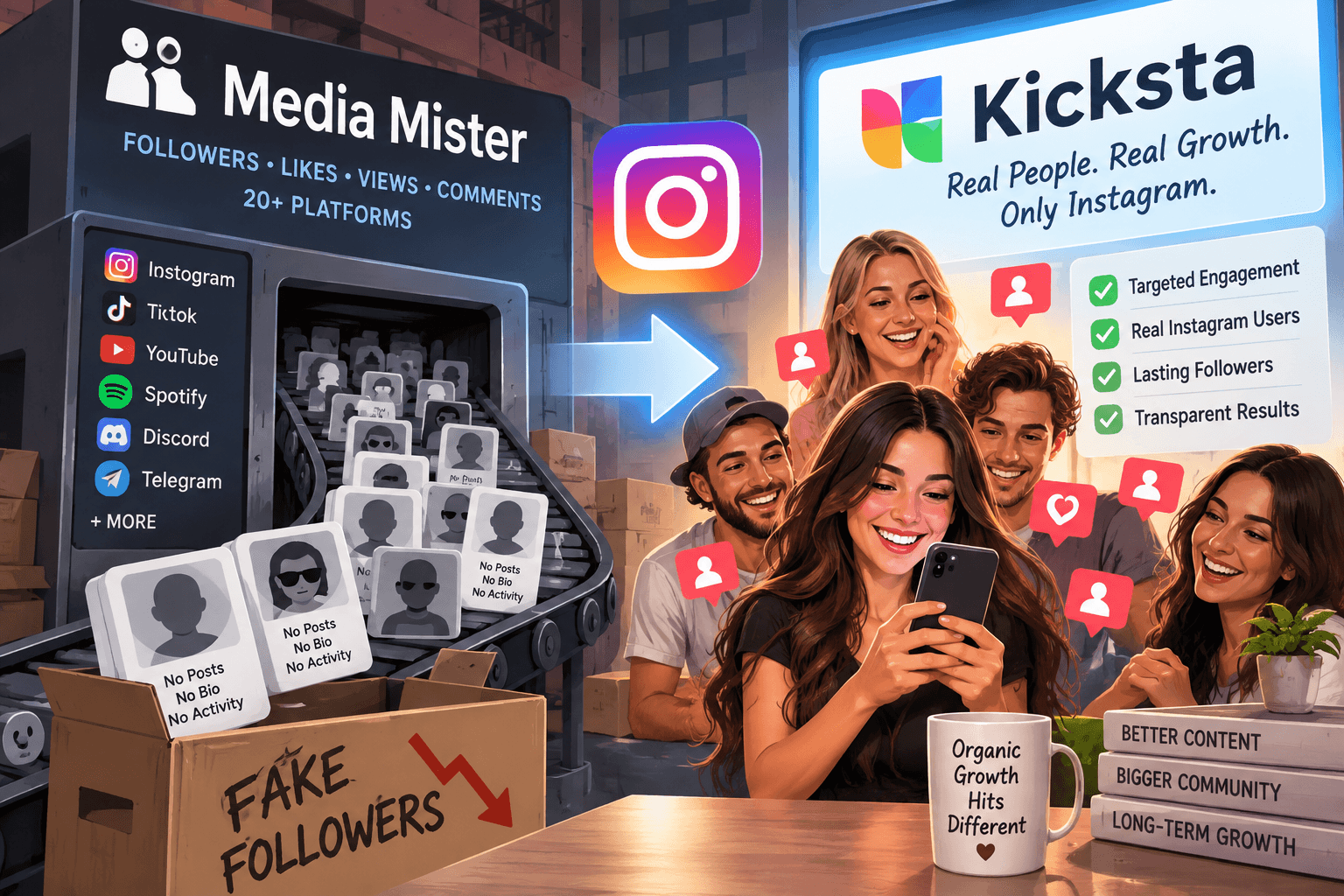
A separate, independent review describes something close to the opposite. It reports followers with "random usernames" and no real engagement, says the numbers "disappear after a week," and warns that the pattern looks like the same fake-engagement risk associated with bot-based competitors — right down to naming Kicksta and Upleap specifically as the safer alternatives to try instead. That's a direct, third-party recommendation for Kicksta over SupGrowth, not something manufactured for this comparison.
To be precise about what this does and doesn't prove: one critical review isn't the same as a confirmed pattern across every SupGrowth customer, and it's possible both reviews are describing genuinely different individual experiences with the same company. But there's a second finding to flag here too, per this project's own practice of surfacing odd findings rather than carrying them over quietly: a direct search for SupGrowth's own Trustpilot listing under its actual domain didn't turn up an independently findable page to check that 4.9-star figure against — so that specific number, repeated by the company and echoed by one reviewer, couldn't be independently verified this session. When two reviews of the same $100-plus-a-month manual service reach opposite conclusions about whether the followers are even real, and the headline rating can't be independently tracked down, that's exactly the kind of thing to know before handing someone 60 unsupervised hours a month of access to your account.
Kicksta doesn't ask you to take a claim like that on faith either way — the engagement runs through real, already-active Instagram accounts, and the growth-analytics dashboard shows exactly what's happening on your account in real time, so there's no manual-labor story to independently verify in the first place; the verification is built into the product rather than something a third-party reviewer has to go dig up separately.
Same Plan, Three Different Prices
SupGrowth's pricing turned out to be genuinely hard to pin down to one number. Its US-facing landing page lists the single Growth plan at $149 a month. A separate landing page — labeled for the US market in its own URL, but displaying its prices in British pounds — lists the same plan at £99 a month. A third source, an independent review of the service, cites $119 a month. There's a 14-day free trial and a money-back guarantee across all three versions, and a "SUM16" discount code knocks 16% off whichever price you land on, but there's no single, transparent rate card a reader can point to — the number changes depending on which page found you first, and which currency that page happened to be set to.
Kicksta vs. Sup Growth: Pricing at a Glance
| Plan | Price | What You Get |
|---|---|---|
| Kicksta Growth | $69/mo $49/mo quarterly · $39/mo annual |
Up to 10 sources, competitor & hashtag targeting, Smart niche filters |
| Kicksta Advanced | $129/mo $99/mo quarterly · $79/mo annual |
Up to 30 sources, plus Welcome DM, Close Friends Adder & Gender filter |
| Sup Growth | $119–$149/mo (£99/mo on one landing page); 16% off with code SUM16 |
300–900+ followers/mo claimed, 60 hrs/mo manual management, single plan |
Kicksta pricing verified live at kicksta.co/pricing. Sup Growth's price varies by landing page — figures reflect what each version of supgrowth.com shows at time of writing.
Kicksta's pricing doesn't have that problem: two plans, the same number wherever you land on the site, with quarterly and annual options that discount predictably rather than depending on which promo code you happen to type in. Even Kicksta's higher Advanced plan, at $79 a month billed annually, comes in below SupGrowth's lowest quoted price — for a service where the price itself doesn't move depending on which page found you or what currency your browser happened to default to.
Two Weeks Free, Compared to Seven Days
Here's a point that genuinely favors SupGrowth: its 14-day free trial gives you twice as long to judge whether manual engagement is producing real growth before you commit a card number, compared to Kicksta's 7-day trial. If you specifically want more time to sit with the results before deciding, that's a real, structural advantage on SupGrowth's side, not a marketing exaggeration — two weeks is a meaningfully longer runway than one.
What that extra week doesn't resolve, though, is the deeper question this comparison keeps circling back to: even with two weeks of data, you're still evaluating a manual process you can't actually see happening — no dashboard, no live target list, just a monthly summary from the same team doing the outreach — against a company whose own headline safety claim ("100% human, no bots") turned out to be exactly the thing one independent reviewer questioned directly. Kicksta's shorter trial comes with a real-time dashboard showing targeting and engagement as it happens, which is a different kind of visibility than a longer runway with no window into the process itself.
The Case for Paying a Human Anyway
There's a real, if narrow, case for SupGrowth that deserves to be taken seriously rather than dismissed outright. Some people have been burned badly enough by bot-based or bulk-follower services that they've decided, as a matter of principle, that they want a literal human being doing the outreach — not an algorithm, not a "growth pod," not anything with the word "automated" attached to it, even when that automation runs through real accounts the way Kicksta's does. If that's genuinely your position — you're not weighing safety records or checkable case studies, you specifically want to know a person clicked "follow" on your behalf, and you're willing to pay a premium and accept some pricing ambiguity for that peace of mind — SupGrowth's pitch is built for exactly that preference, and no amount of dashboard transparency from a competitor is going to address it, because it's answering a different question than the one you're asking.
For nearly everyone else — someone weighing real safety, verifiable results, and pricing transparency — that preference doesn't hold up as a reason to choose SupGrowth specifically, since "a human did it" hasn't been shown here to mean "it's safer" or "it's real," and at least one independent reviewer found evidence pointing the other way.
Picking Between Manual Labor and an Algorithm
Do you specifically want a person, not software, manually working your account by hand — and are you comfortable with a 14-day trial standing in for the pricing clarity and independent verification you'd get elsewhere? SupGrowth's model is built around exactly that preference, at whichever of its three quoted prices you happen to land on.
Do you want consistent monthly growth you can track yourself, backed by named case studies and one transparent price no matter which page you land on? That's what Kicksta is built for, and it's the more common reason people end up comparing these two services in the first place.
The Trade You're Making Either Way
SupGrowth is selling a story about who does the work — a real person, not a bot, spending real hours on your account. Kicksta is selling something you can check: a dashboard, named case studies, and one price that doesn't change depending on which URL found you. The independent reviews of SupGrowth don't agree with each other, its own Trustpilot rating couldn't be tracked down independently, and its pricing shifts by landing page — three separate reasons to be cautious about taking its safety pitch at face value. For most people actually trying to decide between these two services, the deciding factor isn't who's doing the clicking; it's whether you can verify what you're being told, and on that measure, Kicksta is the stronger overall choice.
Sup Growth: The Questions People Search For
Is Sup Growth legit? It's an operating UK-based agency, founded in 2018, not a disappearing-act scam — but "legit business" and "safe, effective service" are different questions, and the evidence on the second one is genuinely mixed, with one independent review specifically warning against it.
Does Sup Growth use bots? The company says no — everything is done manually by a dedicated account manager. An independent review disputes that the results look any different from bot-driven fake engagement in practice, describing followers with random usernames that disappear within a week.
How much does Sup Growth cost? Its own marketing shows different prices on different landing pages — $149 a month on one, the equivalent of roughly $124 (listed as £99) on another, and $119 a month per one third-party review — all for the same single Growth plan, with a 16%-off discount code layered on top of whichever figure you land on.
What do Sup Growth reviews actually say? They split sharply. One review calls it a top pick for genuine, human-powered growth with a 4.9-star Trustpilot rating; another calls it "a trap" with fake followers that vanish within a week and recommends Kicksta and Upleap instead.
What's the alternative if I'm a creator specifically trying to save time, not spend it? Kicksta's content-creator program is built around saving 20 to 40 hours a month through automated targeting — roughly the inverse of SupGrowth's pitch, which bills you for 60 hours of someone else's manual labor instead of giving you back your own.