What SimplyGram's Weekly Price Hides, and What Kicksta Actually Costs
.jpg)
If you've been comparing Instagram growth services, SimplyGram has probably caught your eye for a specific reason: it doesn't automate anything. It promises real micro-influencers personally recommending your profile to their own audiences, no bots, no scripts, no password required. That's a genuinely different pitch from most of what's out there, and it's worth understanding on its own terms. But there's also a second reason people end up researching this comparison, and it usually shows up the moment they do the math on SimplyGram's pricing page: the numbers are listed by the week, and weekly numbers have a way of looking a lot smaller than what actually leaves your account every month.
Both Kicksta — trusted by over 40,000 businesses and creators — and SimplyGram are legitimate services with real customers and real results. Neither uses bots or fake accounts. But they're solving the growth problem from two completely different directions, and one of those directions costs meaningfully more than it looks like at first glance.
Where the Followers Actually Come From
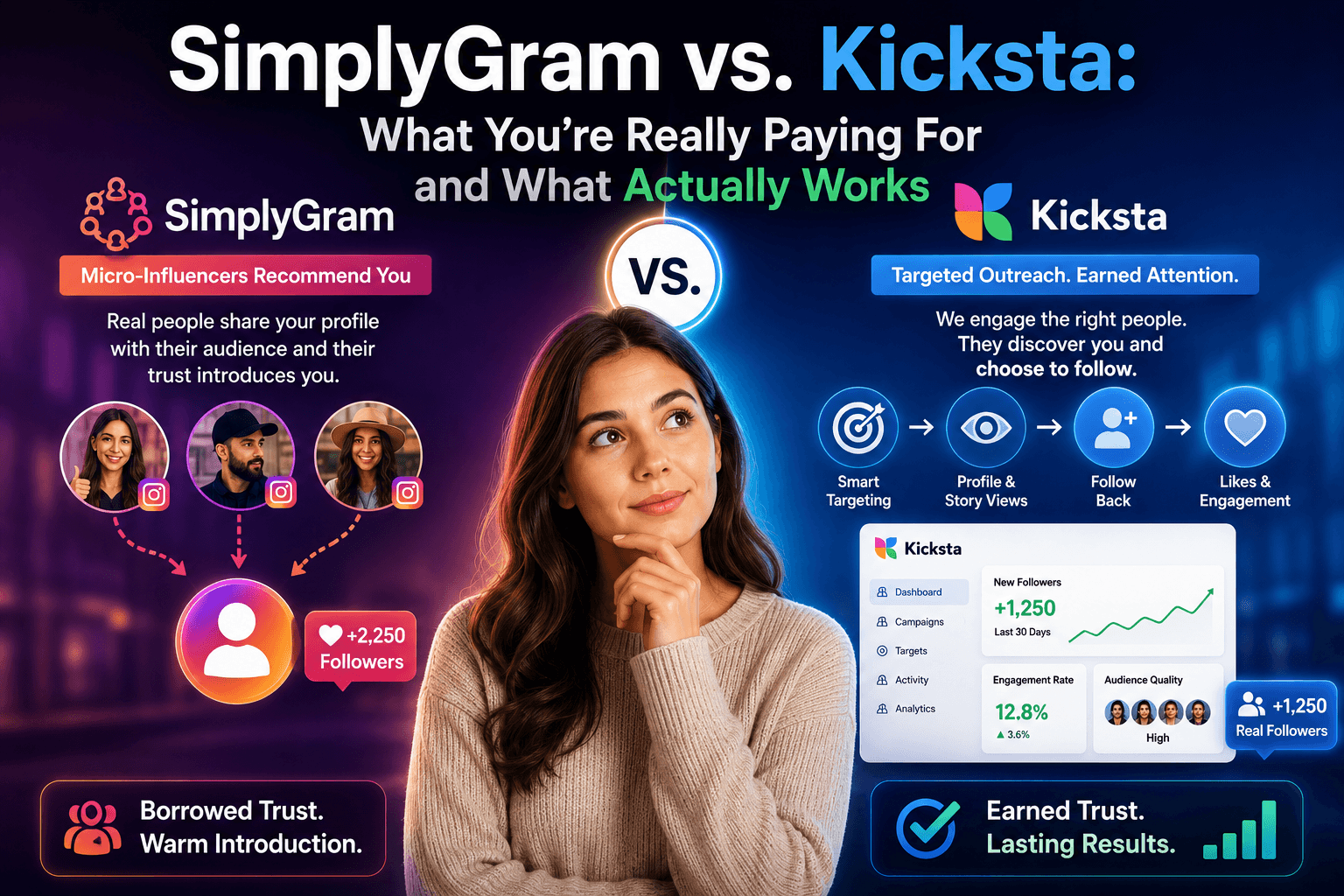
SimplyGram's model runs on borrowed trust. The service maintains a network of 15,000+ vetted micro-influencers, studies your niche, and matches you with creators whose audiences overlap with yours. Those creators then share your profile directly with their followers, on a recurring basis, with a link attached. SimplyGram describes it as "like an army of friends vouching for you, 24/7," which is a fair description of the mechanism: someone your audience already trusts is doing the introducing.
Kicksta runs on earned attention instead. There's no third party vouching for you. The platform identifies real Instagram users who match criteria you set, engages with them directly on your behalf, and lets your profile earn the follow on its own merits once someone actually looks at it. Over 100,000 agencies, brands, and creators currently run their growth this way. Nobody is recommending you to anyone. Your profile shows up in front of the right people, and either it holds their attention or it doesn't.
Both are legitimate paths to real followers. The difference is whether the trust a new follower extends to you was borrowed from someone else, or built directly between your account and theirs. It's the same distinction that separates paid influencer shoutouts from organic Instagram growth more broadly — one borrows an audience that already exists, the other builds a relationship between your account and a new follower from scratch. Kicksta is effectively that second approach automated and run at a scale no person could keep up with by hand.
How Much Control You Actually Get
SimplyGram's targeting happens on the other side of a relationship. You share your profile and describe your niche, and a dedicated account manager selects which influencers in the network to activate on your behalf. You can request adjustments through that account manager, but you're not the one choosing who promotes you or watching the campaign move in real time. It's a collaborative process, built around trusting SimplyGram's team to make good matches.
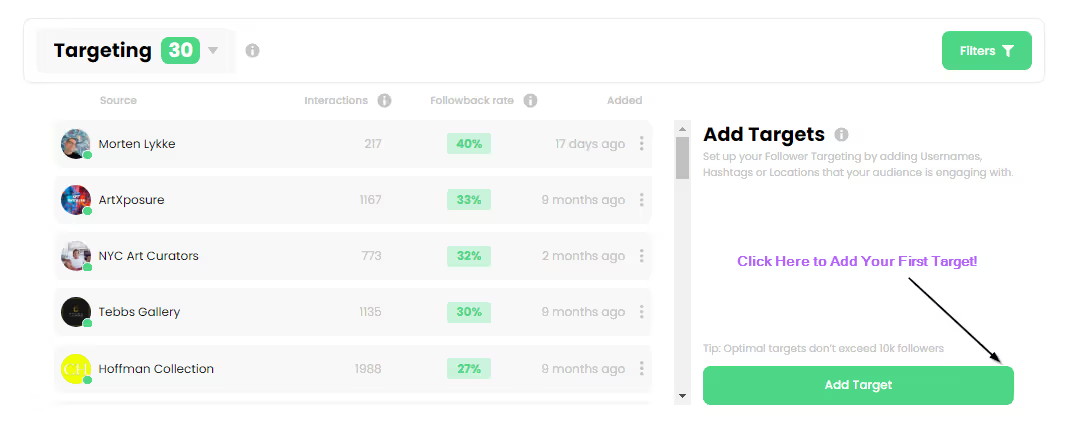
Kicksta puts that same decision directly in your hands. You choose the specific competitor accounts, influencers, and hashtag communities to target, filter by follower count, activity level, post count, and account privacy, and run up to 30 targets (10 on the Growth plan) simultaneously. You watch which targets are actually converting and adjust on the spot, with nobody standing between you and the data. If you're new to targeting and not sure where to start, Kicksta draws on historical performance across major niches to suggest targets that have already worked for accounts like yours.
The practical difference shows up the first time something isn't working. If a target isn't converting on Kicksta, you see it in the dashboard the same day and can redirect toward a different competitor account or hashtag community immediately. If an influencer match isn't landing on SimplyGram, you'd need to notice the campaign underperforming, raise it with your account manager, and wait for them to research and activate a better-fitting creator from the network — a process that plays out over days, not minutes, because it depends on someone else's schedule as much as yours.
The Warm Introduction, and What It Doesn't Guarantee
Give SimplyGram its due here, because the mechanism is genuinely sound. Research on influencer marketing backs up the core idea: micro-influencers generate stronger audience trust, largely because audiences experience micro-influencers as something closer to a friend's recommendation than a celebrity endorsement, and that closeness makes the endorsement feel more genuine. A follower who arrives because a creator they already trust vouched for you does start from a warmer place than a cold introduction.
What that research doesn't promise is that the warmth survives contact with your actual content. The follow-back still depends on how well SimplyGram's chosen influencers actually match your niche, and once someone follows because of a recommendation, their ongoing interest is governed by the same thing everyone's is: whether your content holds up. Kicksta's model skips the borrowed-trust step and goes straight to targeting people already showing behavioral signals of interest in your specific niche — following competitors, engaging with relevant hashtags — which means the follow, when it happens, is a more direct signal of actual relevance than an introduction filtered through someone else's audience.
Kicksta Doesn't Stop at the Follow
SimplyGram's job is largely done once the influencer posts the recommendation. From there, whether someone follows is between them and whoever they just saw vouch for you.
Kicksta treats the follow as one step in a longer sequence. After following a targeted account, it automatically views that person's stories first, creating a touchpoint before any follow-back decision gets made. If they follow back, Like After Follow engages with their recent posts to reinforce the connection, and the Close Friends Adder places them into your Close Friends list — since people associate that green ring with more exclusive content, new followers tend to start noticing (and reacting to) your stories from day one instead of scrolling past them. The Welcome DM waits 3 to 4 days and only goes out to people who actually followed back, which is what keeps the whole sequence feeling like a person paying attention rather than a script that fired the instant someone hit follow.
From the other side of that sequence, what a new follower actually experiences is a handful of small, spaced-out touchpoints rather than one recommendation and silence: your account shows up watching their stories a couple of times, then they see it follow, then a few days later a message arrives that references the fact that they're already following — not a generic "thanks for the follow!" blast sent the second they clicked. None of it requires a team on either end to manage. It just runs, continuously, in the background, long after SimplyGram's influencer post has already scrolled out of anyone's feed.
Knowing What's Actually Happening With Your Account
Open Kicksta's dashboard on any given day and you can watch the activity close to live: which account it just followed, whether they've followed back yet, which target list they came from. You can pull a complete log of every single interaction the platform has made on your behalf. Nothing about what's happening is filtered through a third party before it reaches you.
SimplyGram's visibility runs through your account manager instead. You can ask how the campaign is going, and you'll get an answer, but the speed and depth of that answer depends on your manager's availability and communication style rather than a dashboard you can check whenever you want. Checking in at 11pm on a Sunday because you're curious how a new influencer match is performing isn't really an option the way it is with Kicksta's always-available dashboard — you're waiting for a reply during business hours, from a person, about a campaign that's already been running without you for days. That's not a knock on the service — a managed relationship is part of what people are paying for — but it does mean less on-demand access to your own campaign's data.
Two Kinds of Safe
This is the one place worth staying close to neutral, because both services genuinely earn it. SimplyGram's compliance story is clean and worth taking at face value: because the promotion happens entirely outside your account, through independent influencers posting on their own profiles, SimplyGram never touches Instagram's systems on your behalf at all. There's nothing on your end for Instagram to flag.
Kicksta's safety comes from a different place — the infrastructure itself. Real physical devices, dedicated proxies per account, activity spread through the day in randomized batches instead of predictable bursts, adaptive cooldowns that respond automatically if Instagram signals concern, and a warm-up period before any account reaches full activity. Instagram's guidance on authentic behavior is a reasonable read regardless of which service you're evaluating, since it explains what the platform is actually watching for. Neither service here gives Instagram much to watch for in the first place, which is the honest, unflashy conclusion: SimplyGram is safe because it stays external, and Kicksta is safe because its internal activity is built to look exactly like a real person's.
The Case for Borrowed Trust
To be specific about who SimplyGram is actually built for: if you're a creator or small brand in a niche with an active, well-defined micro-influencer community — beauty, fitness, sustainable living, and similar spaces come to mind — and you'd genuinely rather hand the whole campaign to a team than manage any part of it yourself, the influencer-endorsement model is a real, coherent approach, and the 3-day trial plus 30-day money-back guarantee give you room to test it without much risk. That's a real slice of the people researching this comparison, particularly anyone who's already found success being featured by creators in their space before and wants to formalize that at scale.
It's a similar calculation to the one people make when comparing Kicksta against social media consulting services more generally — a managed relationship is genuinely worth something to the right person, and SimplyGram's version of that trade-off is more affordable and more narrowly scoped than hiring a full agency. Outside of that specific situation, though, the pricing and control trade-offs below tend to matter more than the appeal of the mechanism itself.
What You're Actually Paying, Not What's Advertised
Here's where the weekly framing matters. SimplyGram's three plans are priced at $69, $99, and $199 per week for 10, 20, and 50 micro-influencers respectively. Multiply those out and the real monthly cost is roughly $276, $396, and $796. There's well-documented psychology behind why a price broken into smaller, more frequent increments feels more affordable than the same total presented as one number — Harvard Business School's pricing research describes exactly this mechanism in the context of annual prices broken into monthly ones, and the same logic scales down cleanly to weekly numbers: the total at the end of the month is the same regardless of how it's sliced, but the sliced version reads as smaller.
Kicksta's pricing is monthly and stated plainly:
| Kicksta Growth | Kicksta Advanced | SimplyGram | |
|---|---|---|---|
| Price | $69/month ($39/mo billed annually) |
$129/month ($79/mo billed annually) |
$276–$796/month billed weekly at $69–$199/week |
| What you get | Targeted growth from up to 10 sources | Targeted growth from up to 30 sources | 10–50 micro-influencers promoting your profile |
| Engagement & conversion tools | Not included | Included: Welcome DM, Close Friends Adder, and the Gender filter | Not included; dedicated account manager and strategy consultations on higher tiers instead |
| Model | Ongoing targeted outreach, self-serve dashboard | Ongoing targeted outreach, self-serve dashboard | Managed influencer-network promotion |
| Trial / guarantee | 7-day free trial, guaranteed growth or trial extended | 7-day free trial, guaranteed growth or trial extended | 3-day free trial, 30-day money-back guarantee |
Kicksta's most feature-complete plan, at $129 a month, costs less than half of SimplyGram's entry-level tier. Kicksta's entry plan at $69 a month is roughly a quarter of SimplyGram's entry-level monthly equivalent. That gap isn't a rounding error, and it isn't a knock on SimplyGram's model being worthless for that money — it's a real number that needs to be weighed against how much a warm introduction is actually worth to you, once you're looking at what it actually costs rather than what the pricing page shows first. If a delivered, fixed-quantity model is more what you actually had in mind instead of either an influencer network or ongoing automated outreach, the iDigic Alternative breakdown covers that different comparison in more depth.
The First Week With Each Service
Getting started with SimplyGram means sharing your profile link, describing your niche, and letting your assigned account manager take it from there — no downloads, no technical setup, nothing to configure yourself. It's about as hands-off as onboarding gets, which is exactly the appeal for anyone who wants a team handling the whole thing.
Kicksta's setup is just as fast but stays in your hands the whole way through: connect your account through Instagram's standard verification, set your targeting criteria, and the platform starts working immediately, drawing on historical performance data to suggest strong targets if you're not sure where to begin. There's no account manager to wait on and no strategy call to schedule — the 7-day free trial means you can see real, measurable results before deciding on a plan, and everything about the setup is visible to you from the first minute. For a look at the broader case for why a self-serve growth service is worth it in the first place, Kicksta's own benefits of an Instagram growth service covers that question directly.
Why the Follow-Back Is Just the Starting Line
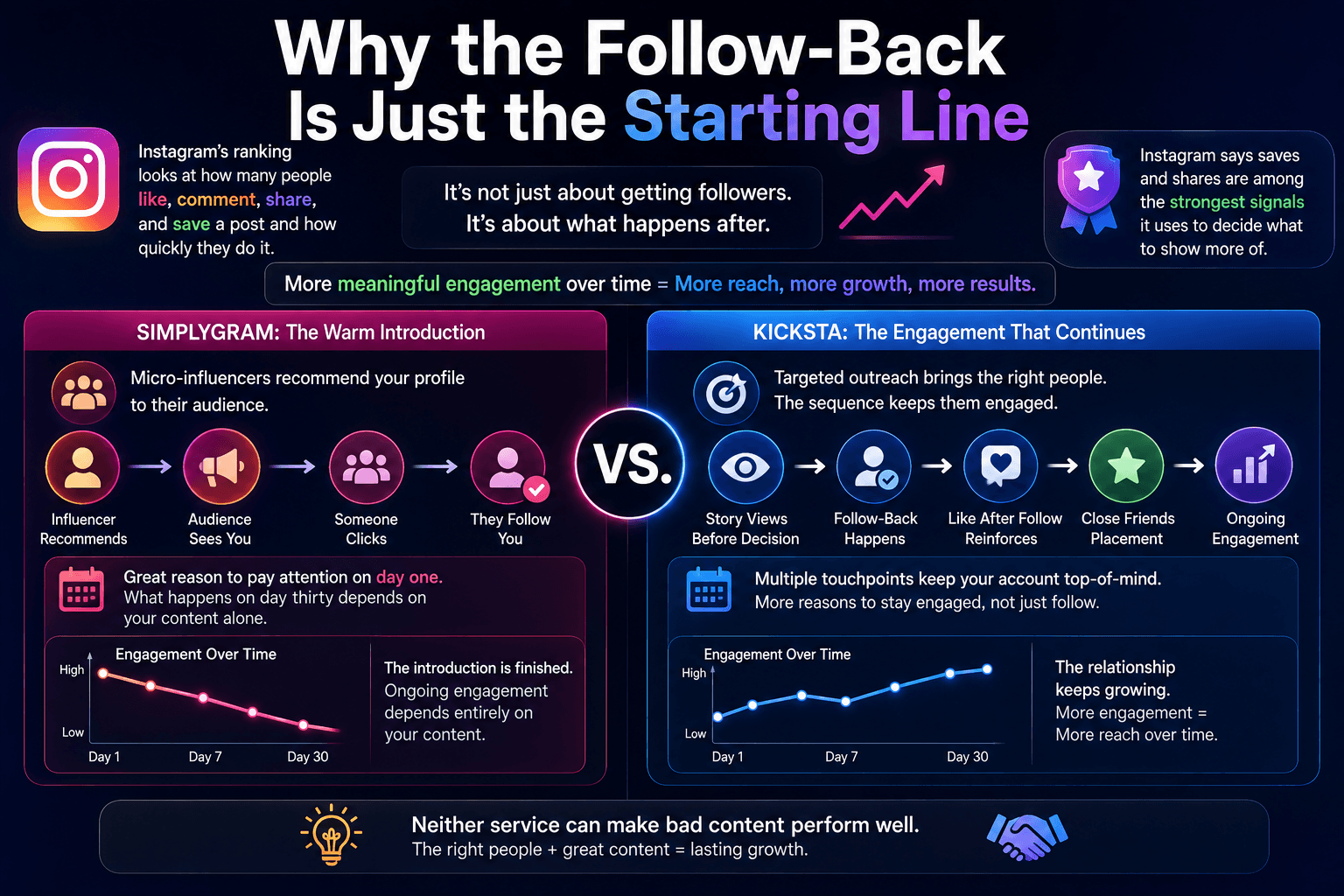
Instagram has been fairly direct about how its own ranking algorithm actually works: the platform looks at "how many people have liked it and how quickly people are liking, commenting, sharing and saving a post" to decide how widely to distribute it, and Instagram's own ranking signals explanation names saves and shares specifically as among the strongest predictors it uses. An account whose followers keep interacting, not just the day they arrive, gets rewarded by that system in a way a follower count on its own never will.
SimplyGram's warm introduction gives a new follower a good reason to pay attention on day one. What happens on day thirty depends entirely on your content, since the service's job — the influencer post, the recommendation — is finished well before then. Kicksta's engagement sequence is built specifically to keep producing touchpoints well past the initial follow: story views before the decision, the reinforcement after it, the Close Friends placement that keeps your stories visible. Each one gives a new follower another reason to stay engaged rather than fading into the follower count. To be fair to both services equally: neither one, automated or influencer-driven, can make people engage with content that isn't actually good. Getting the right people to notice you is only half the job either way.
Common Questions About SimplyGram
Is SimplyGram legit? Yes. It's a real service with a genuine network of vetted micro-influencers, and its compliance approach — staying entirely outside Instagram's systems — is about as clean as this category gets. The thing worth double-checking isn't legitimacy, it's the real monthly cost once the weekly price is converted.
Does SimplyGram actually work? The mechanism is sound and backed by real research on why micro-influencer recommendations tend to land well. The catch is that "works" depends entirely on how well the assigned influencers actually match your niche, and that matching happens on the other side of a relationship you can't see into — you're trusting SimplyGram's team to get it right rather than verifying it yourself in real time, which is exactly the kind of thing a self-serve dashboard would otherwise let you check.
How much does SimplyGram really cost per month? Roughly $276/month on the Individual plan, $396/month on Influencer, and $796/month on Professional — all listed on SimplyGram's site as a weekly number, which is considerably smaller-looking than the monthly total.
Is Kicksta cheaper than SimplyGram? Substantially. Kicksta's most expensive plan, at $129/month, costs less than half of SimplyGram's cheapest tier, and Kicksta's entry plan runs about a quarter of SimplyGram's entry-level monthly equivalent.
Two Quick Questions to Settle This
First: are you in a niche with an active micro-influencer community, and would you rather hand your entire growth strategy to a team than touch any part of it yourself — even knowing the real monthly cost runs into the hundreds? If that's genuinely your situation, SimplyGram's free trial is a reasonable way to test the approach.
Second: do you want direct control over exactly who you're targeting, real-time visibility into what's actually happening with your account, an engagement system that keeps working long after the first follow, and a price that doesn't need to be multiplied by four to understand what you're actually paying? If that's the real goal, which is where most people asking this comparison land once they've done the math, Kicksta is built around exactly that, and the 7-day trial is a low-risk way to see it working before committing to a plan.
Where This Leaves You
SimplyGram and Kicksta are both legitimate, and the micro-influencer model is a genuinely interesting approach to Instagram growth that deserves real credit for what it is. But for anyone whose actual goal is a growing, self-managed Instagram presence rather than a managed campaign billed by the week, Kicksta is the stronger choice on nearly every axis that matters: the targeting is yours to run, the visibility is immediate instead of filtered through an account manager, the engagement sequence keeps working long after the follow, and the price — once you do the same math SimplyGram's own pricing page makes you do — comes in at a fraction of the cost. The 7-day free trial is the easiest way to see that difference for yourself.