Before You Buy Followers From iDigic, See What Kicksta Does Instead
.jpg)
If you're looking at iDigic, you've probably already noticed what makes it appealing: pick a package, enter your username, and the numbers move almost immediately. That's a real, useful thing when you need it. But if you've gotten this far in your research, there's a decent chance you're also asking a second question — will these followers actually do anything for my account once the initial bump wears off?
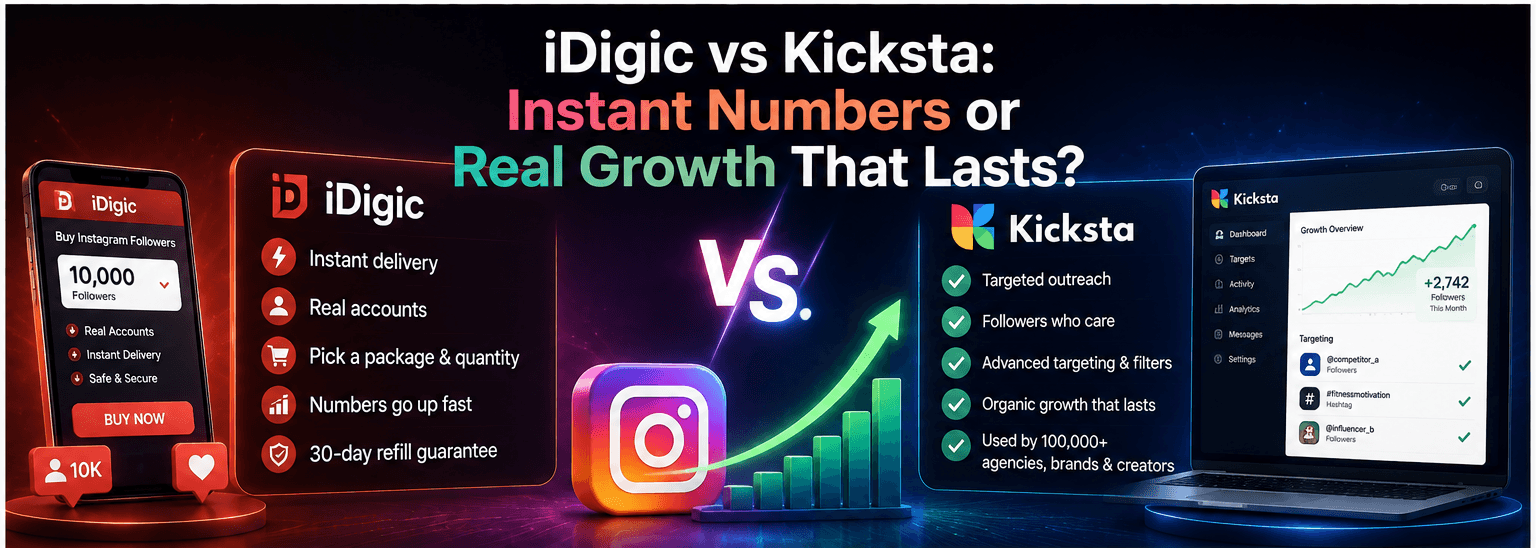
That second question is really what separates Kicksta and iDigic. Both are established, real services. Neither is a scam. But they're solving different problems, and understanding which problem you actually have is most of the decision.
Two Different Starting Points
iDigic has been operating since 2011 and has built its reputation on speed. You choose a package — 500 followers, 1,000 likes, 5,000 views, whatever the goal is — enter your Instagram username, pay, and engagement starts arriving, sometimes within seconds. They say all of it comes from real accounts, not bots, and back it with a 30-day refill guarantee plus a money-back guarantee if delivery falls through. It's a transaction: you buy a quantity, you receive that quantity.
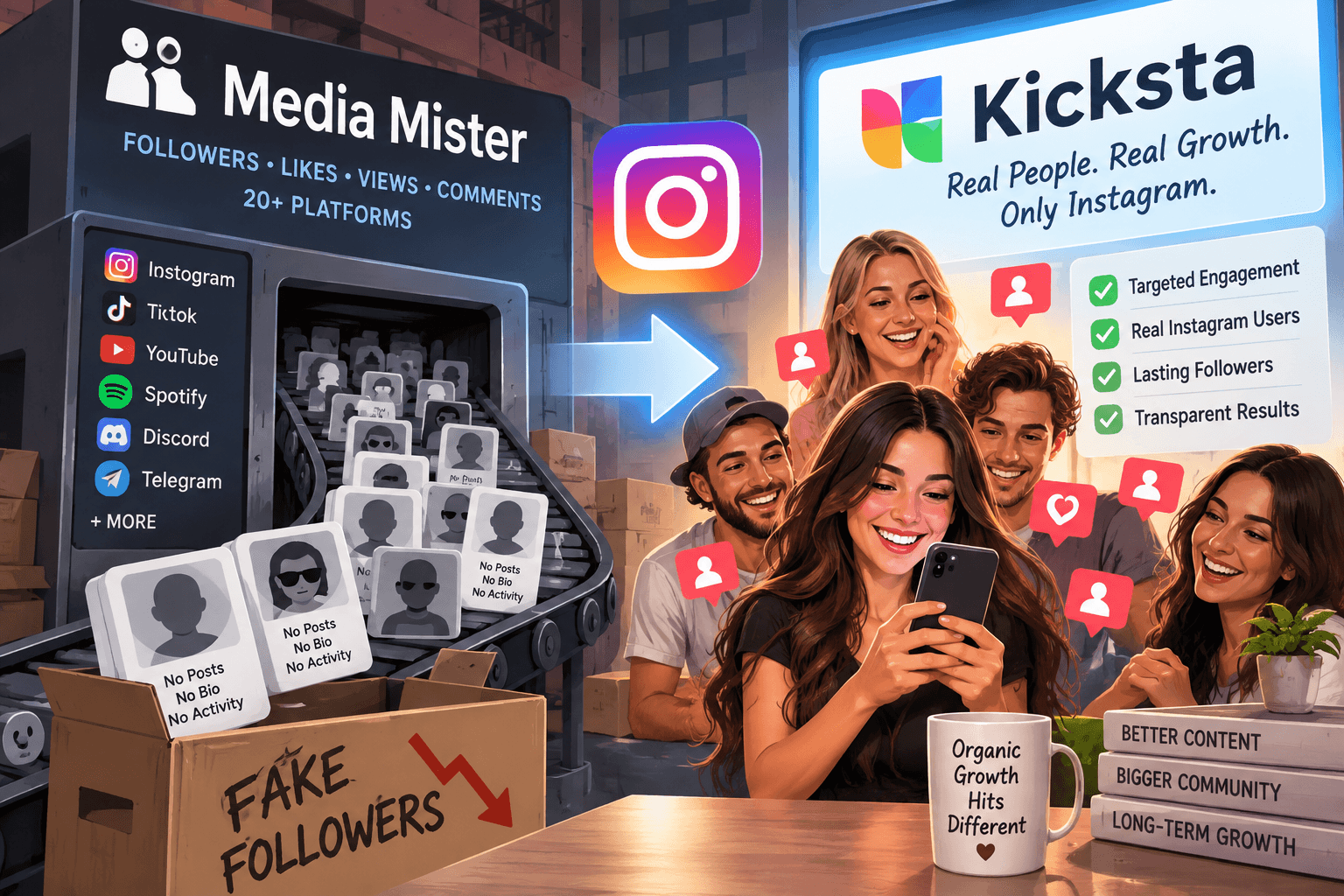
Kicksta starts somewhere else entirely. Instead of delivering a number, it runs targeted engagement — following real Instagram users who match criteria you set, viewing their stories, showing up in their world — so that people who are actually likely to care about your content are the ones deciding to follow you. Nothing arrives as a delivery. It's earned, one real decision at a time, which is slower by definition but produces a different kind of follower than a package ever could. Over 100,000 agencies, brands, and creators are currently running growth through Kicksta on that basis.
Both approaches use real accounts. The difference is what those accounts were doing right before they became your followers — fulfilling an order, or noticing your profile and choosing it.
The Follower Quality Question
This is really the center of the whole comparison. When you buy from iDigic, you get real people, but there's no way to know or control whether any of them have a genuine connection to your niche. The count moves, which is the point of the purchase, but what happens after that is limited by how the relationship started.
Kicksta's followers arrive through a different path: the platform targets people based on real signals of relevance — who they already follow, what hashtags they engage with, which competitors' content they've shown interest in. The people who follow back are doing so because your account showed up as something relevant to what they already care about, at a follow-back rate Kicksta targets at 10% or higher across everyone it reaches out to on your behalf. That's a fundamentally different foundation than a follower who arrived because a package was fulfilled.
Instagram's algorithm tracks engagement rate — how your followers actually interact relative to how many you have — and rewards accounts where that ratio holds up as follower count grows. A spike in followers who don't engage pulls that ratio down, which tells the algorithm your content isn't landing, and that quietly shrinks your reach even among people who already followed you.
Targeting: Something You Control, or Something You Don't
iDigic doesn't offer niche targeting at all. You pick a quantity and receive it — there's no way to specify that you want followers interested in fitness, sustainable fashion, B2B software, or anything else specific to what you actually post about. The engagement is real, but it's generalized by design.
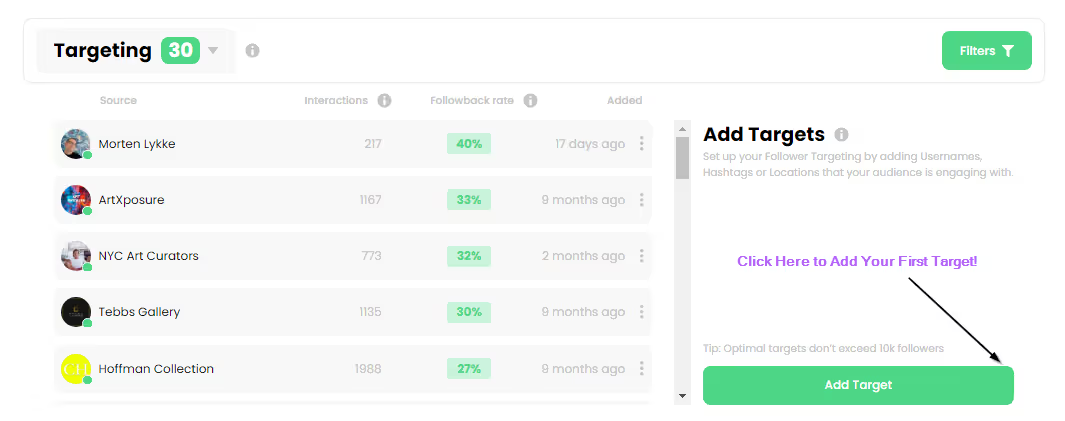
Kicksta's whole targeting system is built around the opposite idea. You can point it at followers of specific competitor accounts, relevant influencers, or hashtag communities that represent your actual audience, then narrow further by follower count, activity level, post count, and account privacy. Up to 30 targets (10 on the Growth plan) can run at once, and the platform draws on historical campaign performance to suggest strong targets if you're not sure where to start. For anyone treating Instagram as a serious channel rather than a one-time boost, the Kicksta blog has ongoing guides on refining targeting and niche audience-building over time.
What Happens After the Follow
Most tools that go beyond a basic follow still stop pretty quickly. Kicksta turns the follow into a sequence. After following someone, it automatically views their stories first — an extra, low-key touchpoint before any follow-back decision gets made. If they follow back, Like After Follow engages with their recent posts, and they're added to your Close Friends list, which tends to mean your new followers start seeing (and reacting to) your Close Friends stories almost right away. The Welcome DM waits 3 to 4 days and only goes out to people who actually followed back — which is the part that makes the whole sequence feel like it came from a person paying attention, not a script firing the second someone hits follow.
Understanding why ghost followers quietly drag down engagement makes it clearer why this sequence matters: followers who've had a few real touchpoints with your account before they ever see it in their main feed already have some familiarity built in, which is a meaningful part of why engagement from this kind of targeted growth tends to outperform followers who arrived through a delivery.
The Kicksta vs Upleap breakdown goes into more detail on how this kind of engagement sequencing stacks up against other tools that also call themselves growth services, and why the sequence — not just the follow itself — is what actually produces the difference.
{{blog-cta-section}}
Safety and Account Risk
iDigic says all engagement comes from real accounts and that their process doesn't violate Instagram's terms. They've operated since 2011, and a large repeat customer base suggests most users don't run into account problems.
Kicksta's safety approach is built into the infrastructure itself: real devices, dedicated proxies per account, activity spread through the day in randomized batches instead of predictable bursts, adaptive cooldowns that respond automatically if Instagram signals concern, and a warm-up period before any account reaches full activity.
According to Instagram's help center guidance on authentic behavior, the platform watches for patterns suggesting coordinated inauthentic activity regardless of whether bots or real accounts are behind it — which is worth keeping in mind for any growth approach, not just one or the other. Kicksta's emphasis on natural device behavior, geographic consistency, and randomized timing is a direct response to exactly that kind of pattern-detection. For more on how this specific kind of infrastructure compares across services, the Kicksta vs SocialCaptain comparison is worth a look.
Where iDigic Actually Makes Sense
To give iDigic its due: if what you need is a fast, low-cost bump to a specific number — more followers before a launch, more likes on one post, more views on a Reel you want the algorithm to notice — iDigic delivers that efficiently, and the entry price (packages start under $2) is hard to beat for a one-off. That's a real, common reason people search for this comparison in the first place, and it's not a use case Kicksta is really built to serve quickly.
Past that specific situation, though, the two services are answering different questions, and most people who get this deep into a comparison like this one are actually asking the second one.
Pricing
iDigic's pricing is genuinely accessible for one-time purchases — followers from $3.49, likes from $1.99, views from $2.95, scaling with quantity. You pay once and receive that amount.
Kicksta runs on a monthly subscription instead:
| Kicksta Growth | Kicksta Advanced | iDigic | |
|---|---|---|---|
| Price | $69/month ($39/mo billed annually) |
$129/month ($79/mo billed annually) |
From $1.99 (likes) / $2.95 (views) / $3.49 (followers) |
| What you get | Targeted growth from up to 10 sources | Targeted growth from up to 30 sources | Fixed quantity per one-time order |
| Engagement & conversion tools | Not included | Included: Welcome DM, Close Friends Adder, and the Gender filter | Not applicable — one-time delivery, no ongoing tools |
| Model | Ongoing targeted outreach | Ongoing targeted outreach | One-time delivery, near-instant |
| Trial / guarantee | 7-day free trial, guaranteed growth or trial extended | 7-day free trial, guaranteed growth or trial extended | 30-day refill guarantee on followers, money-back if not delivered |
The two models aren't really competing on the same axis — iDigic sells a fixed quantity per transaction; Kicksta runs a continuous process for as long as the subscription stays active. Which one is the better value depends entirely on whether the goal is a number that moves once or an audience that keeps growing on its own. Kicksta's own breakdown of Stories analytics is a useful look at what that ongoing process actually produces over time — the kind of deeper story views and replies that come from people who chose to follow, not a delivery that landed in your account overnight.
Getting Started
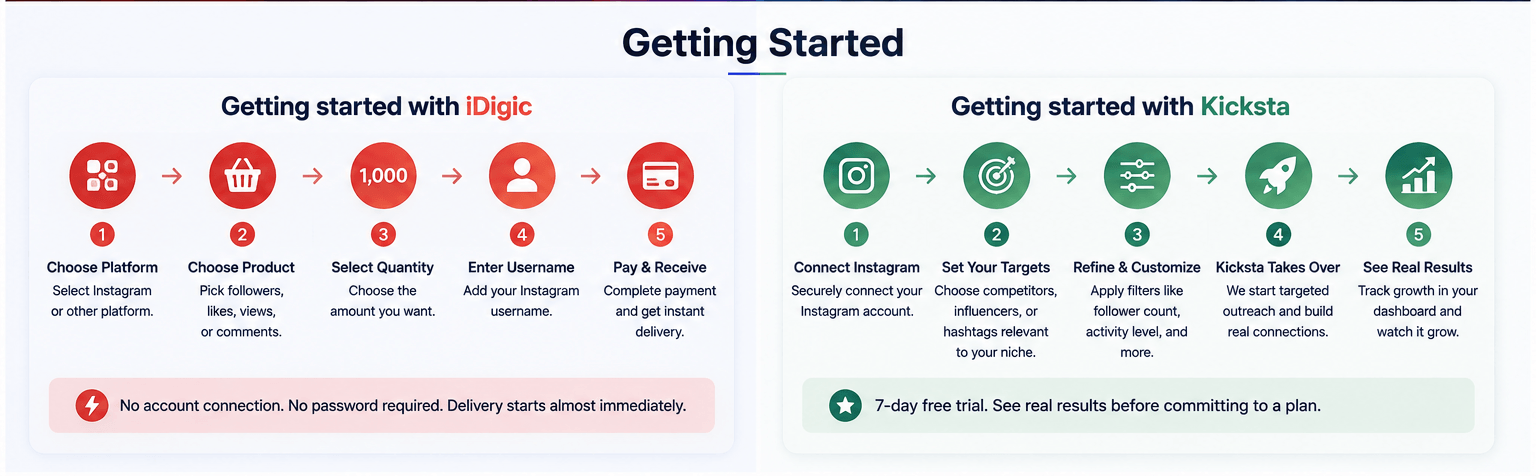
With iDigic, you pick a platform and a specific product — followers, likes, views, or comments — then a quantity, enter your username, and pay. No account connection or password is required, and delivery starts almost immediately.
Kicksta's setup connects directly to your Instagram account, then has you set targeting criteria — competitors, influencers, or hashtags relevant to your niche — and the platform takes it from there, using historical performance data to suggest strong targets if you're new to this. The 7-day free trial means you can see real results before deciding on a plan, without picking a package size upfront.
Results Over Time
An account built on genuinely engaged, targeted followers tends to compound: real engagement improves your rate, a better rate earns wider algorithmic distribution, wider distribution brings in more organic followers on top of what Kicksta is already generating, and those followers improve engagement further. It's a cycle that reinforces itself the longer it runs.
An account whose count grew mainly through delivered packages faces a different pattern — the number moves, but engagement doesn't necessarily move with it, and that gap is exactly what tells the algorithm your content isn't resonating as broadly as the follower count suggests. Distribution narrows instead of widening. It's worth being honest, too, that no growth approach — Kicksta included — can manufacture engagement out of content that isn't connecting with people; targeting the right audience gets the right people in front of your content, but what they do from there is still on what you post.
This is the exact dynamic the Kicksta vs Buzzoid comparison walks through in more detail — how a short-term follower bump and a long-term compounding audience can look identical on day one and completely different six months later. Forbes has made the same point about follower count being a vanity metric on its own — a smaller, genuinely engaged audience tends to generate more real business value than a larger, disinterested one. Research from Baylor University's Keller Center backs that up with actual numbers: nano- and micro-influencers, despite having far fewer followers, consistently showed better ROI and higher revenue per follower than larger accounts, thanks to more authentic audience connections and stronger conversion rates.
If you're weighing this against another delivered-package service specifically, the MySocialFollowing Alternative breakdown covers that same dynamic from a slightly different angle.
Which One Fits You
First: is the actual goal a specific number, by a specific date, where it matters less who's behind it — a follower count before a launch, more likes on one post, more views on a Reel? If that's genuinely the situation, iDigic will get you there fast and cheap.
Second: do you want people following you because they noticed your account and decided it was worth their attention — the kind of audience that responds to stories, clicks links, and actually converts, and that keeps growing on its own the longer it runs? If that's the real goal, which is where most people asking this comparison actually land once they think it through, Kicksta is the one designed around exactly that, and the 7-day trial is a low-risk way to see it working before committing to a plan.
Bottom Line
Kicksta and iDigic both do what they claim, for the audiences they're actually built for. iDigic is fast, cheap, and effective for a one-time metric boost — nothing about that is a knock on the service. But for anyone whose real goal is an Instagram presence that keeps compounding rather than a number that moved once, Kicksta's targeting, its multi-step engagement sequence, and its safety architecture add up to a meaningfully more complete answer. The 7-day trial is the easiest way to see that difference for yourself before deciding.