The AscendViral Alternative Worth Comparing First
.jpg)
If you've been pricing out AscendViral, you've probably noticed the math doesn't quite add up the way it first seems to. The "Turbo" plan is marked 50% off, the follower numbers sound solid, and the pitch — a real person managing your growth, no bots — is genuinely appealing if you've been burned by automation before. But once you sit down and compare what you actually get for the money, a lot of people start looking for something else. That's usually how someone ends up here.
This isn't a case against hiring a human being to manage your Instagram. It's a case for checking whether that's actually what you're paying for, and whether a platform like Kicksta can get you further for less.
Why "A Real Person Does It" Sounds Better Than It Performs
AscendViral's whole pitch rests on one idea: a dedicated "Personal Growth Assistant" hand-picks accounts to engage with in your niche and location, instead of software doing it automatically. No bots, no automation risk — just a person, manually working your account.
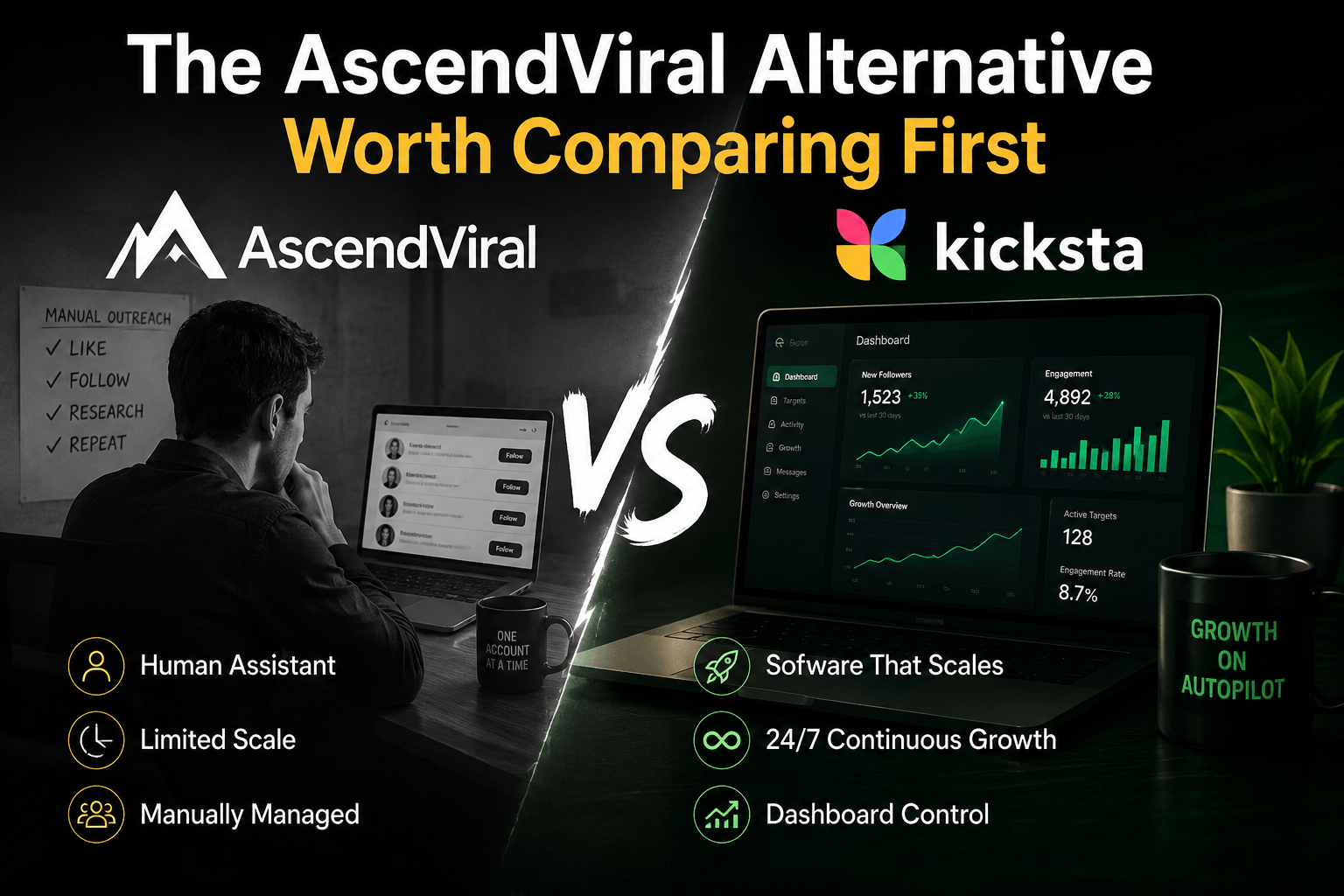
It's an understandable reaction to years of shady automation tools giving the whole category a bad name. The problem is what "a person doing it manually" actually means for scale. A human assistant working across a roster of client accounts can only physically visit, evaluate, and engage with so many profiles in a day. That's not a knock on the assistants — it's just arithmetic. Kicksta runs the same kind of decision-making — competitor and hashtag-based targeting, filtering out bots and inactive accounts, avoiding NSFW and low-quality profiles — through software that doesn't get tired, doesn't have a caseload, and doesn't stop at 5pm. You set the targeting parameters once inside your dashboard, and the engagement runs continuously in the background, all day, every day, across your whole account's active window.
The output reflects that gap. AscendViral's own site advertises 150 to 600+ monthly followers on its entry plan and 300 to 1,000+ on Turbo. Kicksta's Growth plan targets up to 10 sources, and Advanced up to 30, at a lower price than either AscendViral tier. One human assistant working a shared client list and a piece of software built to run continuous, filtered outreach on your account alone are not really in the same category, even though the marketing language ("targeted," "niche-based," "hand-picked") sounds similar on both sides.
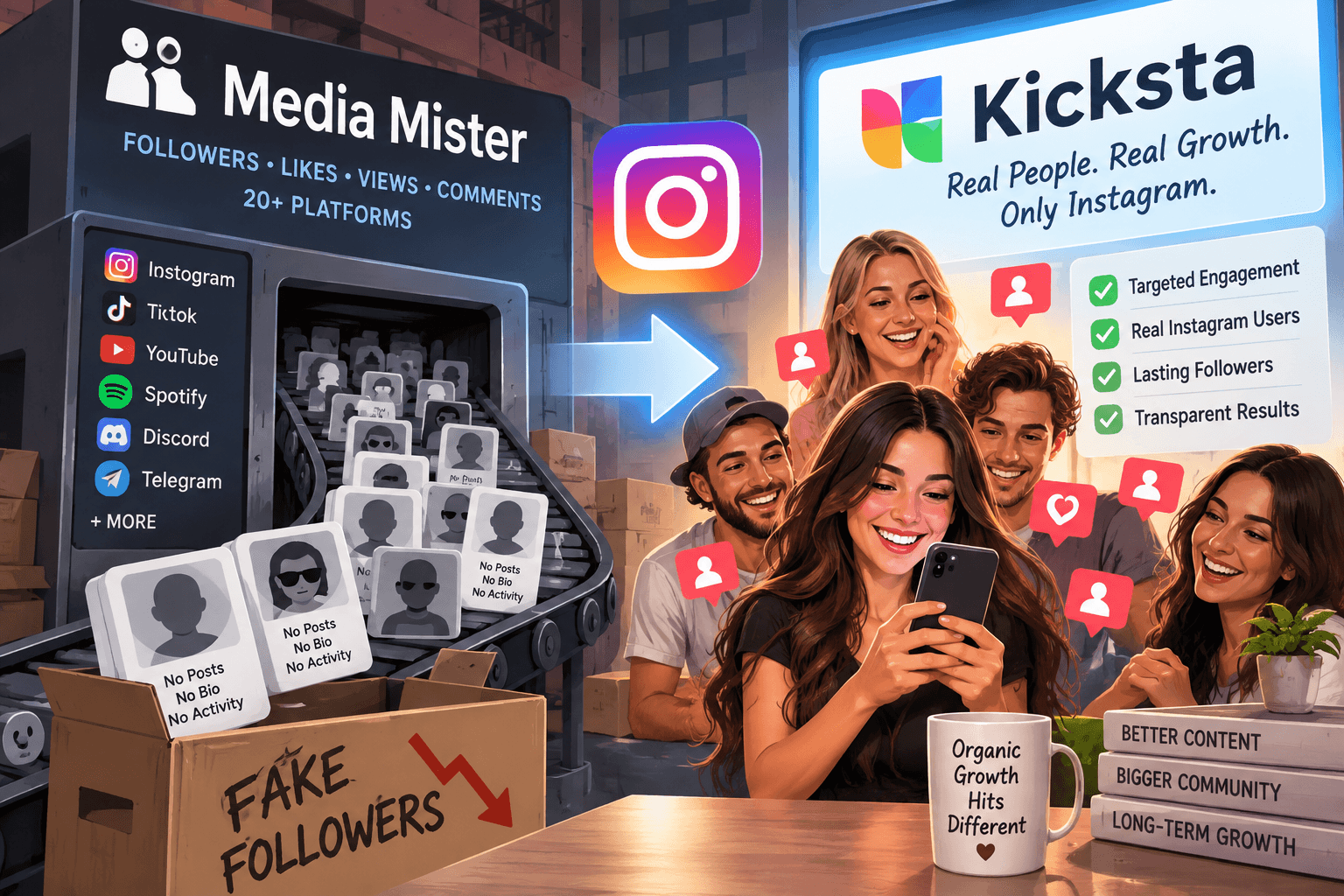
AscendViral isn't the only service built around this pitch, either — Ampfluence's human-powered premise is nearly identical, with an internal team making the targeting calls instead of software. It's worth knowing that "no bots, a real person does it" is a category, not something unique to AscendViral, and every service in that category runs into the same scaling ceiling.
How the Two Approaches Actually Set Up Your Targeting
AscendViral's targeting is built around location — city, zip code, even neighborhood — plus niche and some competitor/hashtag research, all filtered through a person's judgment calls about who looks like a good fit. That's a reasonable approach for something like a single-location business (a bakery, a local gym) that genuinely only wants followers within a ten-mile radius.
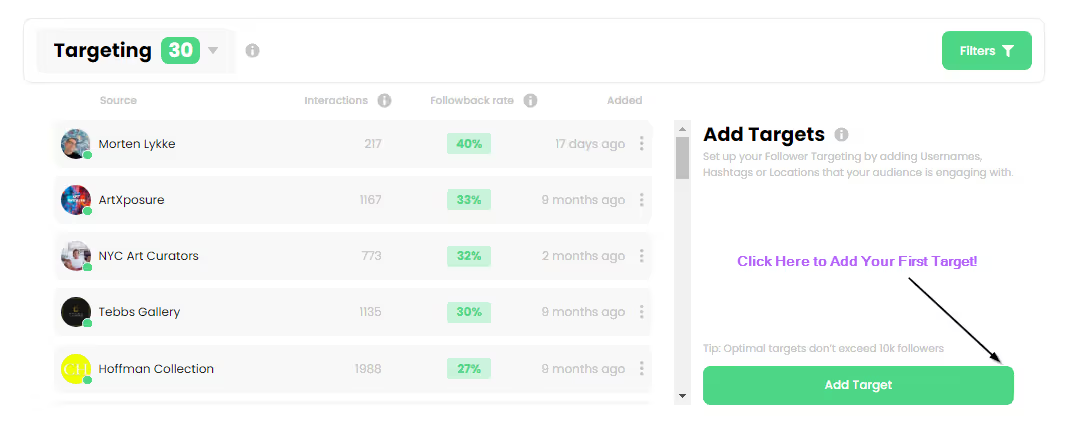
Kicksta covers that same ground — competitor targeting, hashtag targeting, location and language filters, explained in detail on its organic growth features page — but you set and adjust it yourself, instantly, from a dashboard, instead of relaying changes to an assistant and waiting for them to act on it. Want to add three new hashtags this week and drop a competitor account that stopped being relevant? On Kicksta that's a settings change. On AscendViral, it's a message to your assistant and however long it takes them to get to it, since they're managing more than just your account. Kicksta also layers in Block list/Allow list controls and privacy/NSFW screening on both plans, plus the Gender filter on Advanced — the same kind of quality control AscendViral is selling as a manual, human-judgment feature, just running continuously instead of during business hours.
One Manual Touch vs. a Full Follow-Up Sequence
AscendViral's engagement, as far as its own marketing describes it, centers on the assistant liking and following on your behalf — a single, manual touchpoint per target account. Kicksta runs a fuller sequence: an automated Welcome DM goes out after a new follow, and the Close Friends Adder puts your most engaged new followers into a warmer, higher-visibility tier without you lifting a finger. It's a small mechanic, but it changes the first week of a new follower relationship — instead of one like from an account they don't recognize, they get liked, followed, and then a personal-feeling DM within the same day, which is a meaningfully different first impression than a single unexplained like showing up in their notifications.
{{blog-cta-section}}
Manual Doesn't Mean Risk-Free
To AscendViral's credit, "manual, no bots" is a legitimate answer to Instagram's automation crackdowns — a human clicking follow and like isn't triggering the same behavioral flags that a poorly-built bot might. But manual outreach isn't automatically safer just because a person is doing it; an assistant working through a long daily list of targets can still produce the same rapid-fire, repetitive-pattern behavior that gets flagged, especially if they're managing volume across many client accounts from a small set of tools. Kicksta's approach — weekly account audits and behavior patterns designed to look organic rather than bulk — is aimed at the same underlying risk from the software side. Neither company can promise Instagram will never flag an account; both are managing risk, not eliminating it. Instagram's community guidelines are the actual rulebook here regardless of which growth method you use, and no growth service — human-run or automated — has authority to override them.
What the Follower Numbers Actually Mean
It's worth saying plainly: neither AscendViral's manual outreach nor Kicksta's automated targeting can rescue an account with weak content. A growth service, whichever kind it is, gets people to your profile — what keeps them following, commenting, and eventually buying something is still down to what you post. AscendViral's monthly content suggestions are at least an attempt to address that half of the equation, even if it's a modest one. Kicksta doesn't do content strategy for you, and doesn't claim to — the dashboard shows you who's following, unfollowing, and engaging in response to your targeting, which is useful diagnostic information, but it's still information you have to act on.
Where the two do differ meaningfully is consistency. A person's output varies — good days, distracted days, a client list that's grown since you signed up and now gets less individual attention than it used to. Software runs the same targeting logic on day one and day ninety.
It's also worth being honest about why follower count matters at all, since that's the whole reason either service exists. Kicksta's own follower-count trust research — a 377-person study across four business niches — found that profiles with higher follower counts were chosen over lower-follower competitors 85.7% of the time, and rated 1.47 points higher on a seven-point trust scale. Even more telling: among the roughly 59% of respondents who knew follower counts can be bought, 82% still picked the higher-follower brand anyway. The number clearly still moves real purchase decisions. That's not an argument for getting there any way possible — it's the actual case for why it's worth building that number through a method that holds up, rather than one that's slow, expensive, or capped by how many hours a day one person can work.
The One Scenario Where AscendViral Wins
If you run a single-location business where literally every follower needs to be within walking distance — a coffee shop, a small studio, a neighborhood service business — and you'd rather pay a premium for a person who can make judgment calls about hyperlocal relevance than configure targeting filters yourself, AscendViral's model has a real audience. The monthly content suggestions and profile optimization notes that come bundled in also suit someone who wants more hand-holding than a self-serve dashboard, even if it's not the most efficient way to get there. That's a genuine, if narrow, use case — it's just not most people's situation, and it's not cheap for what it delivers.
The Real Cost, Side by Side
AscendViral's Turbo plan is currently marketed at "50% off" its $399 list price — a framing that makes $199 feel like a deal, even though $399 was never really the price most people were expected to pay. Strip that away and just look at the numbers next to what Kicksta charges:
AscendViral vs. Kicksta: What You're Actually Paying
| AscendViral Starter | AscendViral Turbo | Kicksta Growth | Kicksta Advanced | |
|---|---|---|---|---|
| Monthly price | $139/mo | $199/mo | $69/mo | $129/mo |
| Annual price | Not offered | Not offered | $39/mo (billed $468) | $79/mo (billed $948) |
| Monthly followers | 150–600+ | 300–1,000+ | No set number (up to 10 sources) | No set number (up to 30 sources) |
| Trial | 5-day free trial | 5-day free trial | 7-day free trial | 7-day free trial |
| Growth guarantee | Yes | Yes | Yes | Yes |
Pricing and features current as of August 2026. AscendViral figures sourced from ascendviral.com.
At every price point, Kicksta's plan sits below AscendViral's. Even comparing Kicksta's annual Advanced rate ($79/mo) to AscendViral's already-discounted Turbo ($199/mo), you'd pay less than half as much. AscendViral doesn't publish an annual option at all, so there's no lower-cost path to the same service the way Kicksta offers through quarterly and yearly billing.
Waiting on a Person vs. Changing It Yourself
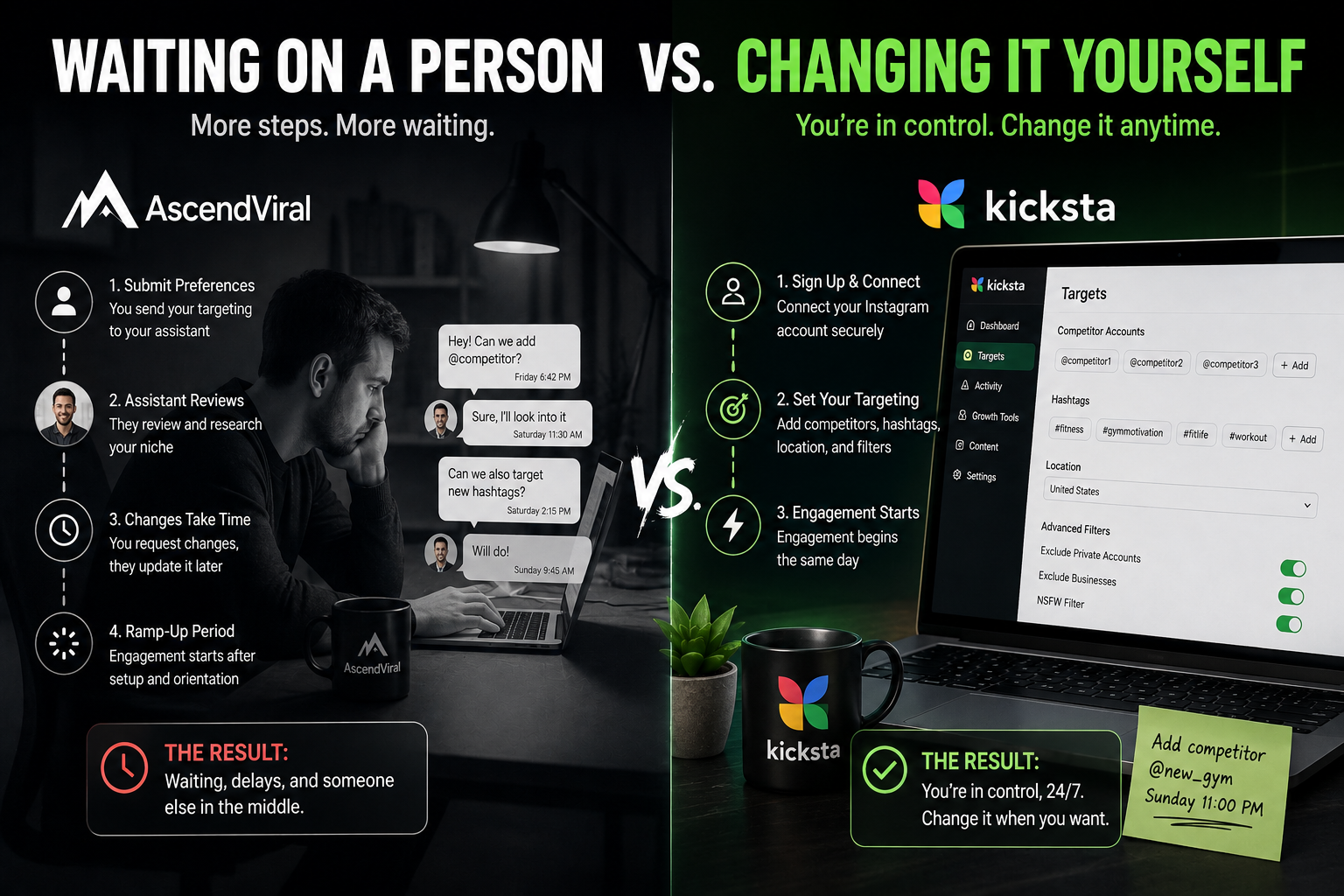
AscendViral's onboarding involves handing off your targeting preferences to an assigned assistant, who then acts as the go-between for changes going forward — there's a person to introduce yourself to, a workflow that runs through them, and a bit of a ramp-up period while they get oriented on your account and niche.
Kicksta skips that step. You sign up, connect your account, and set your own targeting — competitors, hashtags, location, filters — directly in the dashboard, and engagement starts running the same day. There's no one to wait on and no handoff period; if you want to tweak your targeting at 11pm on a Sunday because you just noticed a competitor account that's a perfect audience match, you just do it. For anyone who's used to controlling their own marketing rather than routing it through an intermediary, that difference shows up constantly, not just at signup.
Common AscendViral Questions, Answered Straight
Is AscendViral legit?It's a real, operating service with a public Trustpilot presence and named customer testimonials — it's not a scam in the sense of taking money and delivering nothing. The more relevant question is whether its manual, higher-priced model is worth it compared to what automated platforms deliver for less — and for most people, it isn't.
Does AscendViral actually work?Its own published results — customers gaining roughly 500 to 1,200 followers a month depending on niche — suggest it does move the needle for some accounts.
Why does AscendViral cost more than automated alternatives?Because a human assistant's time is the product, not just the follower growth. Paying someone to manually manage outreach costs more to run than software that scales without adding headcount, and that cost gets passed to the customer.
What happens if I outgrow the manual model?There isn't really a path to more volume on AscendViral beyond upgrading to Turbo — the ceiling is set by how much one assistant can realistically do. Platforms like Kicksta don't have that same ceiling, since the targeting runs continuously rather than being rationed across a person's workday.
Can I switch from AscendViral to Kicksta without losing my existing followers?Yes — switching growth services doesn't affect followers you already have, since neither platform ever needs your password or takes any action on your existing audience. You'd just be changing who's finding and engaging new accounts on your behalf going forward. Kicksta's 7-day trial makes it easy to run the two side by side for a week before committing to anything.
The Two Questions That Actually Matter
If your business genuinely depends on hyperlocal, neighborhood-specific followers and you're willing to pay a premium for a human to make every judgment call by hand, AscendViral's model fits that specific situation.
For nearly everyone else — anyone growing a niche, industry, or interest-based following rather than a single physical location, or anyone who just wants more followers for meaningfully less money — Kicksta's software-driven targeting covers the same ground at less than half the cost, with no one to wait on for changes.
What This Actually Comes Down To
AscendViral isn't dishonest about what it does — a real person really does manage your outreach. But "a person is doing this by hand" is a feature that costs you money and speed without necessarily buying you better results, and the published numbers back that up: a higher price, with less pricing flexibility. Kicksta was built to solve the same trust problem — no bots, real targeting, filtered engagement — without needing to staff a person per account to do it, which is exactly why it can charge less. If you've been comparing AscendViral's plans and feeling like the numbers should look better than they do, that instinct is worth listening to.
If you're weighing a fully managed, higher-touch agency model instead of a manual growth-assistant one, it's worth reading how HypePlanner's team-based approach stacks up against Kicksta too — a different flavor of the same "who's actually doing the work" question. And if AscendViral's discount pricing structure caught your eye, SimplyGram's weekly billing is worth a look for another example of how list-price framing can make a service look cheaper than it is. On the opposite end of the spectrum from a human assistant, Suparise's fully automated approach is worth comparing too — a desktop app that skips the human element entirely, with its own trade-offs Kicksta's cloud-based model doesn't share.