Suparise Costs $19 a Month. Here's the Part That's Easy to Miss.
.jpg)
Nineteen dollars a month is a genuinely hard number to argue with, and it's probably what brought you to Suparise in the first place. Download an app, log in, set your targeting, and a bot quietly follows, likes, and views stories on your behalf while you go about your day. It's Instagram automation stripped down to its cheapest, simplest form.
Kicksta does a version of the same core thing — follow, like, view stories, unfollow — which is exactly why the two get compared. But "the same four actions" is doing a lot of work in that sentence, because where those actions actually happen, and what happens to your account because of it, turns out to matter more than the actions themselves.
Same Basic Moves, Very Different Machinery
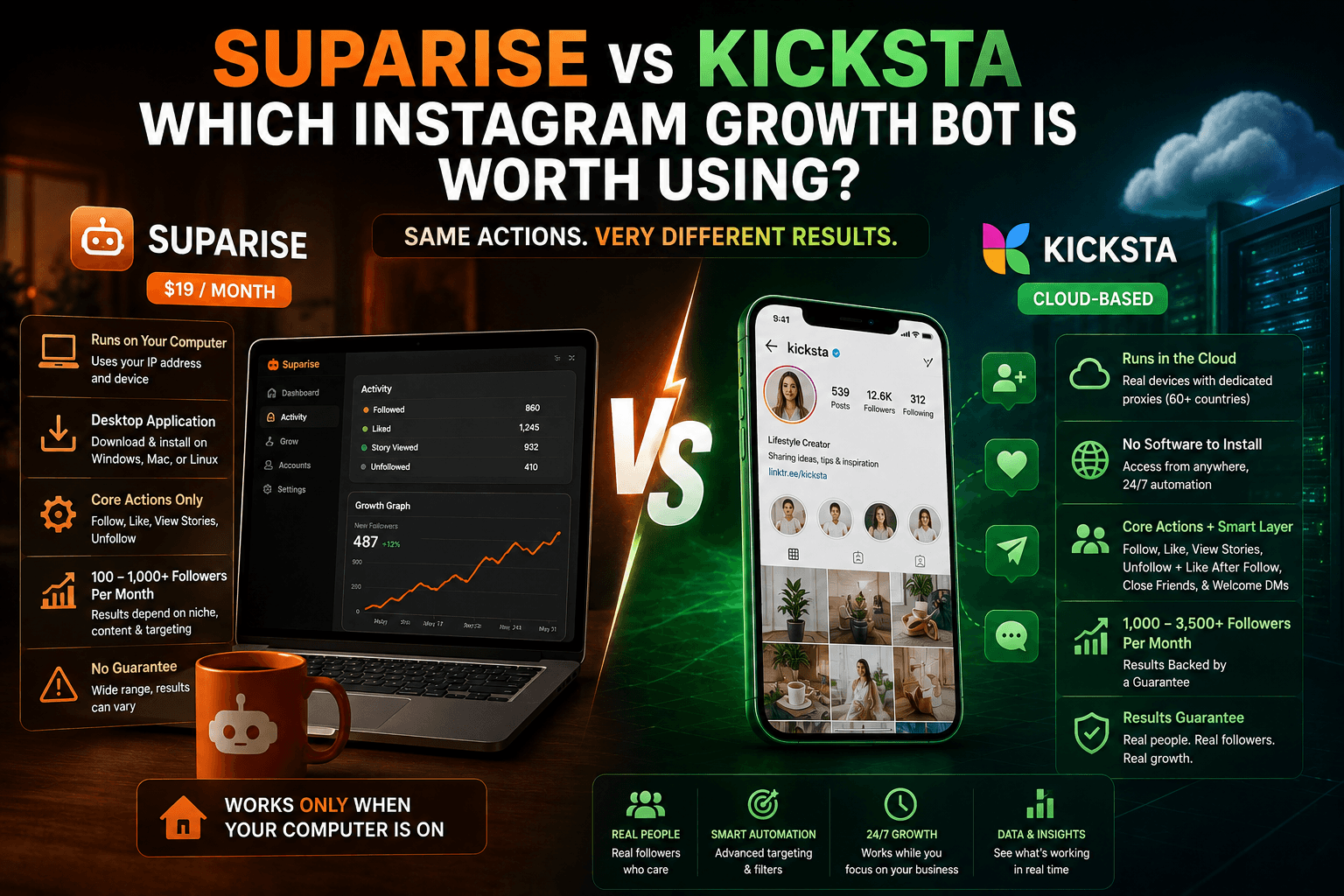
Suparise is a desktop application. You download it, run it on your own computer, and it performs its automation from your own machine using your own home or office IP address. It's built for Windows, macOS, and Linux, takes about five to ten minutes to configure, and Suparise is upfront that the deliberately stripped-down settings exist to keep users from accidentally dialing activity up to something risky.
Kicksta doesn't touch your computer at all. Kicksta runs entirely from its own cloud infrastructure, on real physical devices with dedicated proxies assigned to every connected account, choosable from 60+ countries and dozens of major U.S. cities. Nothing needs to stay open on your end, and your IP address is never part of the equation. The mechanism looks the same on paper — follow, like, view, unfollow — but one version runs from your living room and the other runs from purpose-built hardware that's never involved your network at all.
What Runs on Your Computer
Once installed, Suparise asks you to enter your Instagram login credentials directly into the app, add your targeting (hashtags and accounts similar to the ones you want to attract), and turn on whichever actions you want running — Auto-Follow, Auto-Like, Story Viewing, Auto-Unfollow. From there it works in the background, and you can check an Activity page showing exactly what it did and when, plus a Growth Graph tracking new followers day by day.
Suparise makes a reasonable point about its own model: since the activity comes from your regular network, you don't need to buy proxies if you're only running one account, because the behavior already matches the IP address you normally use. It's a fair argument for a single-account user with a consistent home setup. Suparise is also candid about the limits of what it can promise — the platform is explicit that the best it can do is bring people to your profile, and results depend heavily on your content, landing somewhere between 100 and 1,000 new followers a month depending on niche and targeting.
That range is wide enough to matter in practice. A well-targeted account with strong content might land near the top of it; a newer account with generic targeting could just as easily sit near the bottom, and there's no guarantee attached either way to tell you which one you're getting until a month or two has actually passed.
What Runs Without One
Kicksta's targeting works from the same basic ingredients — competitor accounts, relevant influencers, hashtag communities — but layers in more precision: five-dimension filters on follower count, following count, post count, privacy, and activity level, running across up to 30 simultaneous targets (10 on the Growth plan). New accounts aren't starting from a guess, either, since Kicksta draws on historical performance data across similar niches to recommend targets that have already converted well for comparable accounts.
After a warm-up period, the system scales to roughly 400 actions a day — about 12,000 a month — aimed at a follow-back rate of 10% or better, backed by guaranteed growth in 7 days, or Kicksta extends your trial. That is a meaningfully different commitment than Suparise's honest but wide 100-to-1,000 range with no guarantee attached.
The Layer Suparise Doesn't Have
Suparise's four actions cover the core engagement loop cleanly, and it doesn't pretend to do more than that. Kicksta builds an entire additional layer on top of the same core mechanics, and this is really the heart of the comparison.
After a targeted user is followed, their stories get viewed automatically, which creates a familiarity touchpoint before any follow-back decision happens. Once someone follows back, Like After Follow engages with a couple of their recent posts to make the connection feel mutual rather than one-directional, and they're placed into your Close Friends list — which does something subtle but real, since people tend to check stories from accounts behind the green ring first. A welcome DM goes out, but only after three to four days, and only to people who actually followed back, so by the time it lands, the recipient has already seen your account appear a handful of times. It reads like someone who noticed them, not a bot that fired the instant they tapped follow. None of this exists in Suparise's model at all — its four actions are the entire relationship between your account and a new follower.
When the Bot Only Works If Your Laptop Does
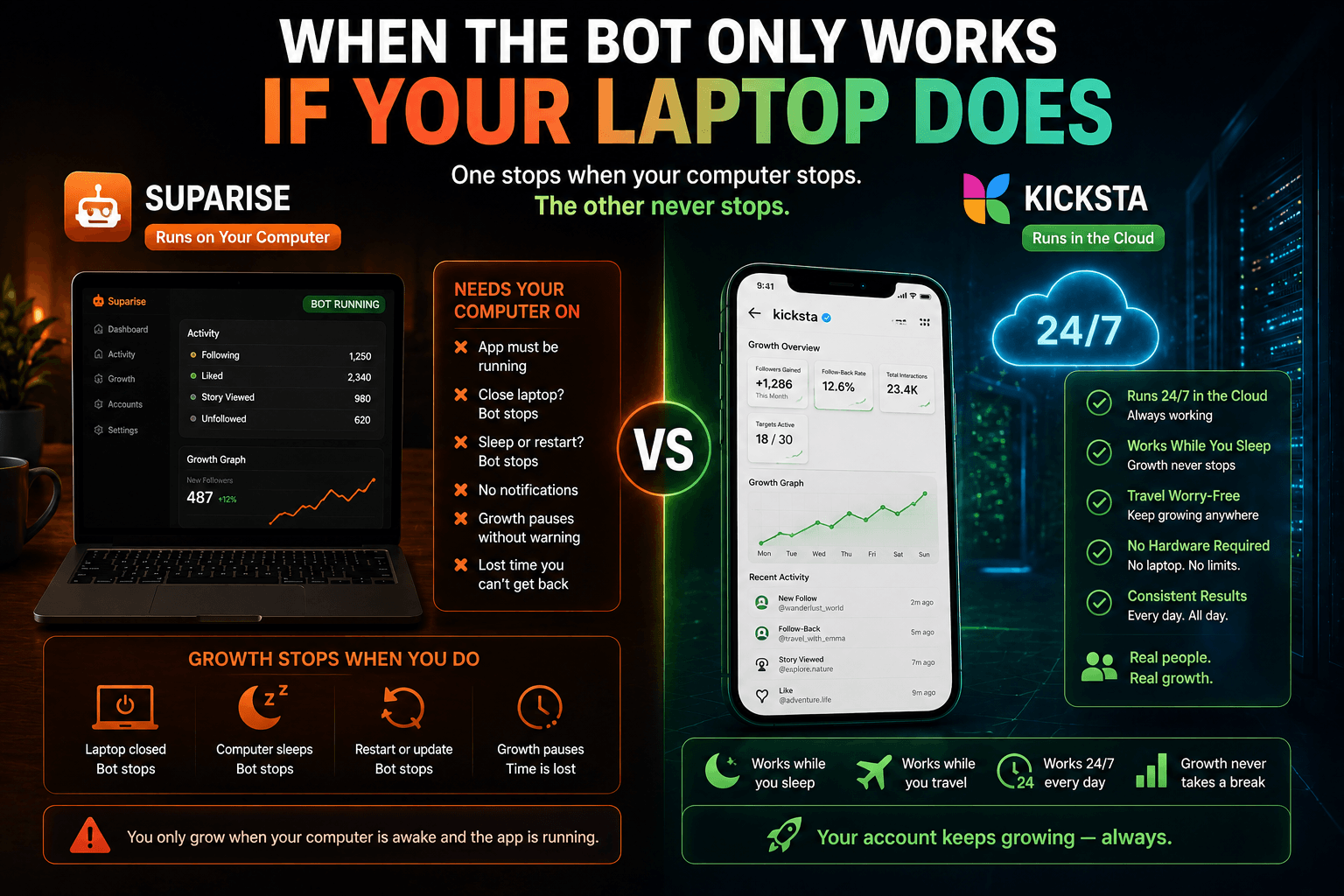
This is the most practical, day-to-day difference between the two, and it's worth being concrete about it: Suparise needs your computer on and the application actively running. Close your laptop, restart your machine, or let it go to sleep, and the bot stops working until you open it again. For someone who works from a desktop that's basically always on, that's a non-issue. For someone who carries a laptop around, closes it constantly, or just doesn't want to think about whether their machine happens to be awake right now, it's a real, recurring limitation — growth quietly pauses every time the computer isn't running, with no notification and no way to know how much time was lost until you check back.
Kicksta runs 24 hours a day regardless of what you're doing with your own devices. Your account keeps growing while you sleep, while you're traveling with your laptop packed away, while your computer has been off for three days. There's no hardware dependency built into the model at all.
Two Different Definitions of Safe
Suparise is refreshingly honest about its own risk profile: the worst case it describes is a 24-to-72-hour action block, a temporary restriction Instagram applies when it flags unusual activity, and it correctly notes that action blocks can happen even without any automation running. Its mitigation is architectural simplicity — the settings are deliberately limited so users can't accidentally configure something too aggressive.
Kicksta's approach layers several things at once: real devices and dedicated proxies that make activity look like one consistent person, daily actions distributed in randomized batches rather than uniform mechanical patterns, and an adaptive cooldown system that automatically pulls back on follow and unfollow activity — shifting to lower-risk actions like story-viewing — the moment Instagram signals any concern. It's worth knowing, too, that automation tools running from a fixed home IP with no adaptive response have a track record here: Instagram has previously shut down unmonitored bot-based automation tools, which is exactly the category of risk a cooldown system is designed to catch before it becomes a problem.
Neither claim is a guarantee, and it would overstate things for either service to promise otherwise — Instagram's own rules are what actually govern this, regardless of which tool is running underneath. What's true is that the two are managing meaningfully different exposure: Suparise is managing a single, stripped-down account's risk from one fixed IP, and Kicksta is managing daily activity across thousands of accounts with automated responses built to catch problems before a human would ever notice them.
There's also a practical asymmetry worth naming: if Suparise's action block does happen, you're the one who finds out, usually by discovering that follows and unfollows have stopped working and the app is throwing an error, with no automatic recovery beyond waiting it out. Kicksta's cooldown response is designed to happen quietly in the background — pulling back before a block occurs rather than reacting to one after the fact — which is a meaningfully different experience even when both approaches are, in the end, honest about not being able to promise zero risk.
{{blog-cta-section}}
The Honest Limit of Both Systems
It's worth being straightforward about something that applies to both services equally: neither one can make weak content perform well. Suparise's own materials say as much — it can bring people to your profile, but what converts them into followers is your content, not the bot. Kicksta's post-follow engagement sequence can build familiarity and give a new follower every reason to stick around, but it can't manufacture a reason to be interested in an account that has nothing worth being interested in. The mechanics get someone to look. What they see when they get there is still entirely up to you.
Where a $19 Bot Is Genuinely the Right Call
There's a real reader who's better served by Suparise, and it's worth saying so plainly: someone running a single account from a desktop that's on most of the day anyway, who's cost-sensitive, wants the simplest possible setup, and doesn't need the post-follow engagement layer to make the math work for them. Ten minutes of setup and $19 a month is a genuinely hard combination to beat if that's what you actually need. If you're weighing Suparise against a similar desktop-based tool rather than a cloud platform, our Combin vs. Kicksta breakdown covers that same local-software-versus-cloud trade-off from another angle.
Where it runs out of road is anyone whose laptop travels, closes, or sleeps more than it stays open, or anyone who wants the post-follow relationship-building that Suparise's model simply doesn't include at any price point.
What You're Actually Paying For
Suparise is a single flat-rate plan at $19/month, with every feature included and no tiers to choose between. A 7-day free trial requires no credit card, extensions are reportedly available on request, and discounts apply for managing additional accounts.
Kicksta runs two monthly tiers. The Growth Plan is $69/month ($39/month billed annually) and lets you target up to 10 sources. The Advanced Plan is $129/month ($79/month annually), lets you target up to 30, and adds Welcome DM, Close Friends Adder, and the Gender filter. Both tiers include targeting, the post-follow sequence, and Allow list and Block list controls. Both come with a 7-day free trial and guaranteed growth: if you don’t see growth in your first 7 days, Kicksta extends your trial.
Suparise vs. Kicksta: What You're Actually Paying For
| Suparise | Kicksta Growth | Kicksta Advanced | |
|---|---|---|---|
| Pricing | $19/month flat | $69/mo ($39/mo annual) | $129/mo ($79/mo annual) |
| Runs from | Your own computer | Kicksta's cloud, real devices | Kicksta's cloud, real devices |
| Typical growth | 100–1,000/mo, no guarantee | Up to 10 sources, guaranteed growth in 7 days or trial extended | Up to 30 sources, guaranteed growth in 7 days or trial extended |
| Post-follow engagement | None | Full sequence included | Full sequence included |
| Computer dependency | Required to be on and running | None | None |
At $19 a month, Suparise is cheap in a way that's hard to argue with in isolation. But the comparison that actually matters is what a follower is worth once they arrive — a follower from a system with no post-follow engagement architecture is worth less over time than one who's been through story views, a reciprocal like, and a welcome message that lands after they've already noticed your account a few times.
Getting Each One Running
Suparise's setup is quick and refreshingly beginner-friendly: download, enter your credentials, configure targeting, and turn on the actions you want — five to ten minutes and you're running, with a growth graph to check in on whenever you think of it.
Kicksta takes a little more time up front because there's more to configure: choosing a proxy location, verifying your account, and building out your first targets. It's a one-time setup rather than something you maintain, though, and once it's live, the dashboard becomes something you glance at rather than manage — every follow, follow-back, and interaction logged, with a full record of which target is actually converting, so underperforming targets can be swapped out for ones that are working instead of just running indefinitely on autopilot.
Common Questions About Suparise
Is Suparise legit? Suparise says over 2,500 businesses, marketers, and creators use the platform, and it's transparent about both its pricing and its risk profile. It's a real, functioning tool — the more useful question is whether a desktop-dependent bot fits how you actually use your computer.
Does Suparise actually work? Suparise itself is honest that results depend on content and targeting quality, landing somewhere in a 100-to-1,000-follower range per month with no guarantee attached. That range is wide because outcomes vary widely by niche and how the bot is configured.
What happens if I close my laptop? The bot stops running until the application is active again on that machine. There's no cloud fallback — the automation lives entirely on your computer.
Is Suparise safe to use? Suparise is upfront that the worst case is a temporary 24-to-72-hour action block, and that its stripped-down settings are meant to prevent users from configuring something too aggressive. It's a reasonable, honestly stated risk profile for a single-account, home-IP setup.
What if I want something that keeps running and does more after the follow? That's the specific gap Kicksta closes — cloud infrastructure with no computer dependency, plus a post-follow engagement sequence Suparise doesn't have at any price. (If a managed, human-curated alternative is more what you're picturing instead of another automation tool, our SimplyGram Alternative breakdown covers that different model.)
Two Questions to Sort This Out
Is your computer reliably on and unattended for most of the day, and are you mainly looking for the cheapest possible way to automate the basics? If so, Suparise's $19 flat rate and simple setup genuinely deliver what you're looking for.
Do you want growth that keeps running no matter what your own devices are doing, backed by a guarantee, with an engagement layer that continues after the follow? That's a broader, more common starting point for most people comparing these two seriously — and it's the case Kicksta is actually built to make.
What Actually Separates Them
Suparise is a well-built, honestly marketed tool for exactly what it is: a cheap, simple desktop bot that does the basics and doesn't pretend to do more. If your setup and expectations match that description, $19 a month is a genuinely good deal.
Instagram's own ranking signals reward consistent engagement, not just follower count — and that's the gap Suparise's model was never built to close, since its job ends at the follow. Kicksta's infrastructure costs more and asks for more patience, but it's built around the part that happens after someone follows back, running independent of whatever your own computer happens to be doing at any given moment. For anyone building an Instagram presence they expect to still be growing next year, that difference is worth more than the $50 a month it costs to get it.