Like4Like Runs on Trading Favors. Kicksta Runs on Real Interest.
.jpg)
If you've spent any time researching Like4Like, you already know the basic pitch: like other people's posts, follow other people's accounts, and in exchange the community does the same for you. It's free, it's been around since 2012, and for a lot of people that's genuinely appealing. But if you've gotten far enough into your research to be reading a comparison like this one, there's a good chance you're also asking whether followers who show up because a credit system told them to are actually the followers you want.
That question is really the whole comparison. Kicksta and Like4Like aren't competing for the same kind of follower, and figuring out which kind you actually need matters more than which service has the better price.
Two Different Ideas About Where a Follower Should Come From
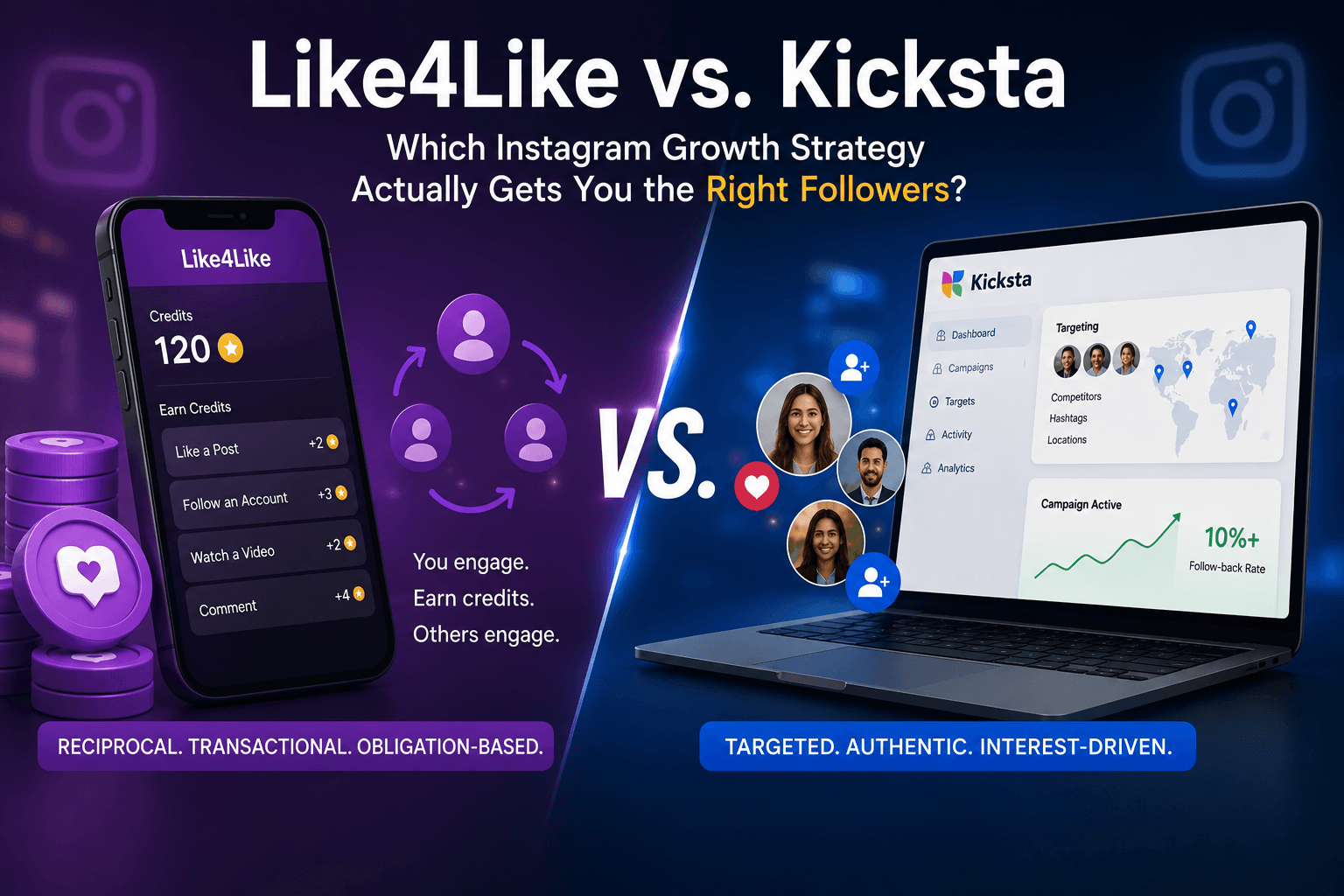
Like4Like runs on a credit-based exchange. You engage with other members' content — liking, following, watching, commenting — and that earns credits, which you spend to have other members do the same for you. It's a reciprocal loop: everyone in it gets engagement because everyone in it is obligated to give some back. You can also skip the participation step and buy credits directly if you'd rather pay than earn.
Kicksta starts from a different place entirely. There's no obligation loop and nothing to earn. Instead, Kicksta runs targeted outreach on real Instagram accounts that match criteria you set — following them, viewing their stories, showing up in their activity — so that people who are actually likely to care about your content are the ones who see your profile and decide, on their own, to follow it. Nobody in that chain owes anybody else a follow-back. A person either finds your account worth following or they don't.
Both models involve real accounts; Like4Like is upfront that it isn't using bots, and that's worth taking at face value. The difference is what those real accounts were doing right before they landed on your profile — completing a task to earn a credit, or noticing something in their feed that caught their attention.
Follower Quality: Circumstantial vs. Chosen
This is where the two models actually diverge in practice. A follower who arrives through Like4Like's exchange is there because the credit system prompted the interaction, not because anything about your content specifically caught their eye. Like4Like says as much itself — its own site notes that engagement from these followers "may not always be highly engaged," which is a fairly candid admission for a growth service to make about its own product.
Kicksta's followers arrive through a different sequence. You define who Kicksta should reach — people who follow specific competitor accounts, engage with certain hashtags, or fit criteria you set around activity and niche — and the follow-back happens because someone looked at your profile in that context and decided it was relevant, at a rate Kicksta targets at 10% or higher across everyone it reaches on your behalf. That's a follower whose first interaction with your account was genuine interest, not a transaction.
Instagram's ranking systems weight engagement rate heavily. They measure how much your followers actually interact relative to how many of them there are, and a follower base that doesn't engage pulls that ratio down over time, which quietly narrows how far your content travels even to people who already follow you. A credit-exchange follower and a genuinely interested follower can look identical in a follower count. They don't behave the same way six months later.
Targeting: A Country Filter, or Real Niche Precision
Like4Like's targeting stops at geography — you can direct exposure toward specific countries or regions, which is a real feature if you're running a local business. Beyond that, the exchange model has no way to specify who you actually want engaging with your content. Everyone in the credit pool is a candidate, regardless of whether they have any actual interest in personal finance, skincare, fitness, or whatever your account is actually about.
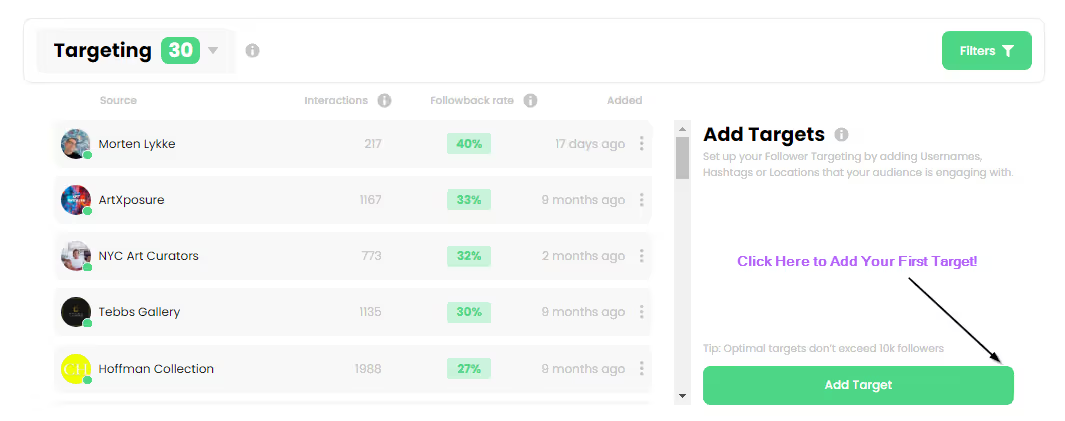
Kicksta's targeting is built around exactly the thing Like4Like can't offer: real niche precision. You can point it at followers of specific competitor accounts, relevant influencers, or hashtag communities that represent your actual audience, then filter further by follower count, activity level, post count, and account privacy, running up to 30 targets (10 on the Growth plan) at once. The platform also draws on historical campaign data across major niches to suggest targets that have already worked for accounts like yours, so a first-time user isn't starting from a blank page. For anyone weighing this against buying followers outright instead of building an audience with any targeting logic, that gap only gets wider.
{{blog-cta-section}}
What Happens After Someone Follows
Like4Like's model doesn't really have a next step — a task gets completed, a credit gets spent, the engagement lands, and that's the end of the interaction. Kicksta treats the follow as a beginning rather than an endpoint. After following a targeted account, Kicksta automatically views that person's stories first, which puts your name in front of them again before any follow-back decision happens. If they follow back, Like After Follow engages with their recent posts, and they're added to your Close Friends list, so your new followers tend to start seeing — and reacting to — your Close Friends stories almost right away.
The Welcome DM is the part that's easy to underrate. It waits 3 to 4 days and only fires for people who actually followed back, which is what keeps it from reading like an automated script firing the second someone hits follow. From the other side, what that looks like is someone who followed you a few days ago, saw a couple of your stories since, and then gets a message that feels like it came from someone paying attention — not a bot, and not a credit-system obligation either.
Safety and Account Risk
It's worth being precise here rather than persuasive, because safety claims are exactly the territory where overstating things backfires. Like4Like is unusually transparent about its own limitations — it includes pacing controls to avoid unnatural spikes, and it openly says results aren't permanent and that platform changes can affect delivery. That kind of honesty is genuinely rare in this category.
The underlying exposure with any reciprocal-exchange system, though, is structural. Large numbers of accounts engaging with your content because a participation system told them to, rather than because they're actually interested, can look like coordinated activity to Instagram's detection systems, even when every account involved is real and human. This isn't unique to Like4Like specifically. Researchers at NYU studied "engagement pods," a similar reciprocal-exchange pattern, and found Instagram's systems detectable enough to flag pod-style comments with around 90% accuracy based on generic, repetitive language patterns alone, the kind of "nice pic" comment a reciprocal system tends to produce because the point is completing the exchange, not genuine reaction. Kicksta's infrastructure is built to avoid that signature entirely: real devices, dedicated proxies per account, randomized activity spread across the day instead of predictable bursts, adaptive cooldowns that respond automatically if Instagram signals concern, and a warm-up period before any account reaches full activity. Instagram's own guidance on authentic behavior is worth reading regardless of which service you're evaluating, since the platform watches for coordinated patterns generally, not just for bots specifically.
Kicksta also gives you Allow list and Block list controls over exactly which accounts get engaged with, which is a more direct kind of control than either service's pacing settings alone.
Where Like4Like Actually Makes Sense
To give it a fair hearing: Like4Like's own site describes itself as built for "early-stage creators testing initial content visibility" and explicitly says it's "not recommended for large brands with established audiences" — which is an honest bit of positioning most growth services don't bother making. If you're a brand-new creator with no budget, trying to figure out whether a particular content format or hook gets any traction at all before you spend money on anything, and you're fine putting in daily time across Instagram, TikTok, YouTube, or wherever else you're testing, the free credit system is a real, low-stakes way to get that initial signal. That's a genuine use case, and it's a fair number of the people who land on a comparison like this one — just not most of them.
Past that specific, early-stage situation, the two services stop being direct competitors and start answering different questions.
Pricing
Like4Like's free tier is genuinely free — you earn engagement by participating rather than paying. Premium packages with purchased credits are available at added cost for people who'd rather skip the participation step.
Kicksta runs on a monthly subscription instead:
| Kicksta Growth | Kicksta Advanced | Like4Like | |
|---|---|---|---|
| Price | $69/month ($39/mo billed annually) |
$129/month ($79/mo billed annually) |
Free (credit-based) premium credit packages at added cost |
| What you get | Targeted growth from up to 10 sources | Targeted growth from up to 30 sources | Engagement earned through participation, or purchased as credits |
| Engagement & conversion tools | Not included | Included: Welcome DM, Close Friends Adder, and the Gender filter | Not applicable — reciprocal exchange, no targeting |
| Model | Ongoing targeted outreach | Ongoing targeted outreach | Reciprocal credit exchange, or pay-to-skip |
| Trial / guarantee | 7-day free trial, guaranteed growth or trial extended | 7-day free trial, guaranteed growth or trial extended | Free to start; no guarantee on retention or long-term results |
Free and $69/month aren't really comparable on the same axis unless you count the time Like4Like's free tier actually costs. Earning credits means logging in daily and engaging with other members' content — which is a real, ongoing time investment that a monthly subscription for automated, 24/7 outreach doesn't ask for. Whether that trade is worth it depends entirely on whether your bottleneck is money or time. If you'd rather see how this looks against a delivered-package competitor instead of an exchange platform, the Likes.io vs Kicksta breakdown covers that different model specifically, and the iDigic Alternative breakdown walks through the same delivered-package dynamic from another angle.
Getting Started
Signing up for Like4Like means creating a free account, connecting your Instagram profile, and starting to complete tasks — liking, following, watching — to build up credits you can spend on your own account's engagement. There's a real learning curve to figuring out how much daily participation earns how much return, and premium packages are there if you'd rather buy credits outright.
Kicksta's setup connects to your Instagram account once, then has you set targeting criteria — competitor accounts, influencers, or hashtags relevant to your niche — and the platform runs from there without any daily task list to manage. The dashboard shows what's happening close to live: which account it just followed, whether they followed back yet, and which target list they came from, so you're never guessing where a new follower came from the way you would be with a credit pool. The 7-day free trial means you can see real results before committing to a plan. If a fully human-run alternative is more what you had in mind instead of either an automated platform or an exchange community, the Jumpgram Alternative breakdown covers that comparison specifically. For brands and businesses specifically weighing whether a growth service is worth it at all, Kicksta's own breakdown of what a growth service actually does for a business is a useful read before you commit either way.
Frequently Asked Questions
What do Like4Like reviews generally say? Opinions tend to track the same split Like4Like describes about its own service: people testing early-stage content generally find it does what it promises, a free visibility signal, while people looking for sustained, targeted growth tend to run into the same limitation described above, that credit-earned engagement doesn't translate into an audience that keeps interacting on its own.
How does Like4Like's credit system actually work? You complete engagement tasks on other members' content — likes, follows, views, comments — and each one earns credits. You spend those credits to have other members complete the same kinds of tasks on your content. You can also buy credits directly instead of earning them through participation.
Is there a way to get Kicksta's kind of targeting without spending hours a day earning credits? Yes — that's essentially the structural difference between the two. Kicksta's targeting runs continuously in the background once you set it up, with no daily task list required. The trade is a monthly subscription instead of free participation, but for anyone whose real constraint is time rather than money, that trade tends to be worth it.
Which One Fits You
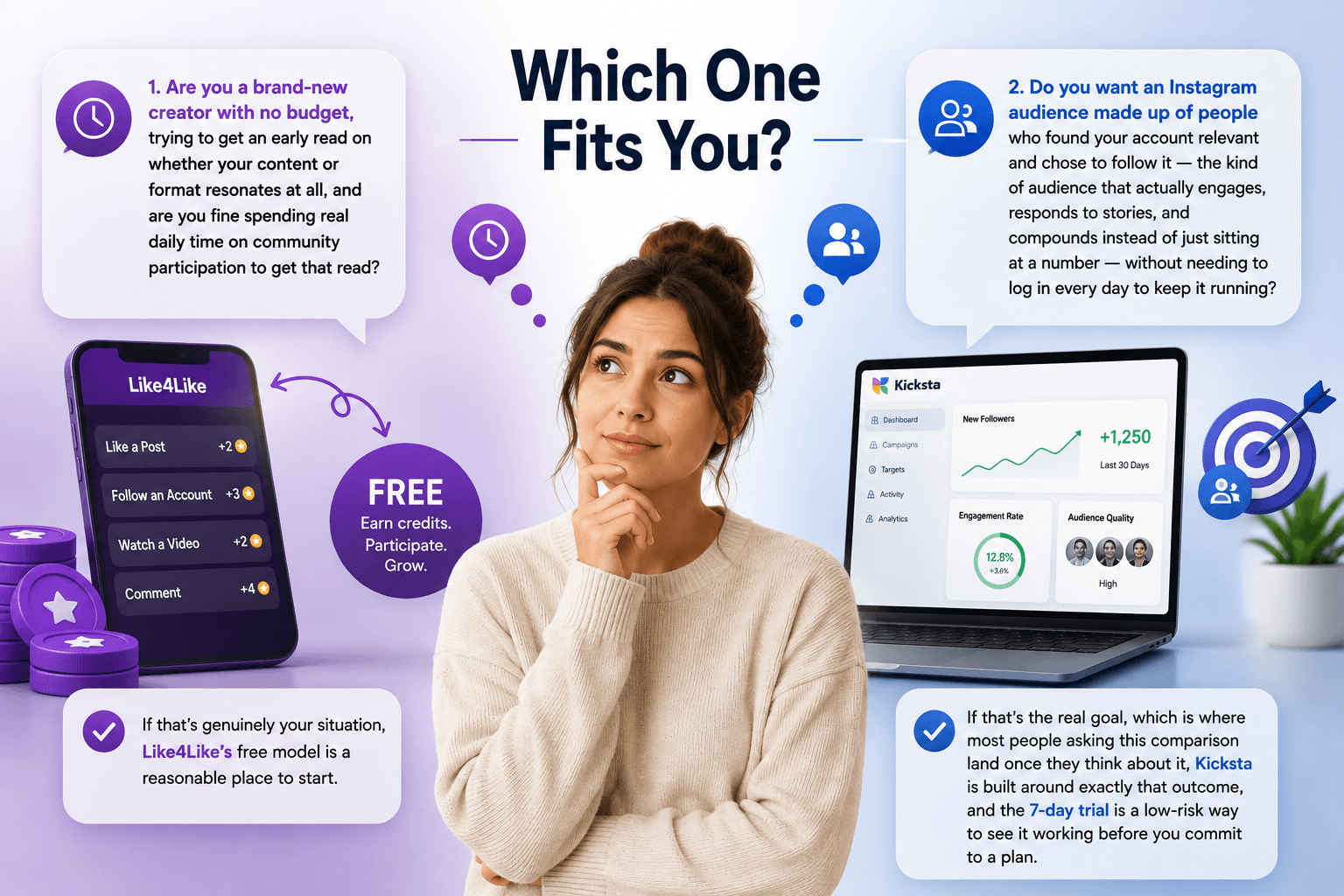
Two questions to sort this out.
First: are you a brand-new creator with no budget, trying to get an early read on whether your content or format resonates at all, and are you fine spending real daily time on community participation to get that read? If that's genuinely your situation, Like4Like's free model is a reasonable place to start.
Second: do you want an Instagram audience made up of people who found your account relevant and chose to follow it — the kind of audience that actually engages, responds to stories, and compounds instead of just sitting at a number — without needing to log in every day to keep it running? If that's the real goal, which is where most people asking this comparison land once they think about it, Kicksta is built around exactly that outcome, and the 7-day trial is a low-risk way to see it working before you commit to a plan.
Bottom Line
Like4Like is a legitimate service that's honest about what it is and isn't built for, and for a creator testing early-stage content with zero budget, that honesty is worth something. But for anyone whose actual goal is a real, growing Instagram presence rather than a free trial run, Kicksta is the stronger choice. Its targeting is precise instead of geography-only, its engagement sequence gives followers real reasons to stick around instead of a one-time reciprocal transaction, and its safety architecture is built specifically to avoid the detection risk that any reciprocal-exchange system structurally carries. That's a more complete answer to actually growing on Instagram, and the 7-day trial is the easiest way to see the difference for yourself.