Looking for a Jumpgram Alternative? Here's Why Kicksta Is Worth a Look First
.jpg)
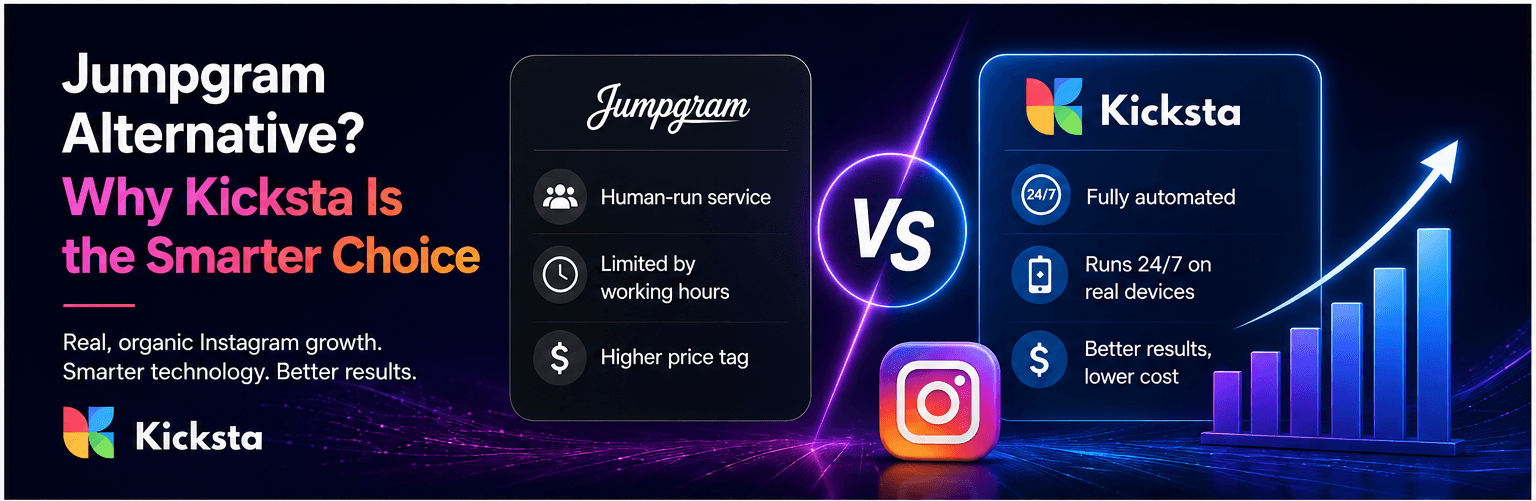
If you're searching for a Jumpgram alternative, you've probably already hit the same wall a lot of people do: Jumpgram is a solid, human-run service, but it comes with a higher price tag, less day-to-day visibility, and a pace that's naturally limited by working hours instead of round-the-clock software. None of that makes it a bad service — it just means it isn't the right fit for everyone.
Kicksta is the alternative most people land on. It goes after the same core promise — real, organic Instagram growth without bots or purchased followers — but gets there through fully automated, real-device infrastructure instead of a small human team. Below is a full, honest breakdown: how each service actually works, where they genuinely differ, what it costs, what it feels like to use, and which one fits which kind of account.
Why People Start Looking for a Jumpgram Alternative in the First Place
It's usually one of a few things. Some people sign up for Jumpgram expecting daily visibility into what's happening on their account, and find out the review cadence is monthly or bi-weekly instead — which feels slow if you're used to checking analytics dashboards the way you'd check email. Others get quoted a price for the Guru Pack once they need more volume and start comparing it against what automated platforms charge for similar output. And some just want more say over who gets targeted, rather than trusting an in-house algorithm and a team they've never met to make those calls on their behalf.
None of that means Jumpgram is doing anything wrong. It means the model — a small human team, working standard hours, at a price that reflects real labor — doesn't fit every use case. That's exactly the gap Kicksta is built to fill.
Two Different Bets: Software or a Small Team
Jumpgram is built around people. A small team manually engages with targeted Instagram users on your behalf, using an in-house algorithm to flag likely follow-backs based on interests, location, and engagement patterns. On higher tiers, that same team also handles ad budget and content strategy, positioning Jumpgram closer to other managed-service competitors in this space than to a pure growth tool.
Kicksta bets on infrastructure instead. It's a fully automated platform, trusted by more than 100,000 agencies, brands, and creators, running on real physical devices with a dedicated proxy for every connected account. Pick from 60+ countries and dozens of major US cities, and the activity reads like a real person logging in from a consistent location — a level of infrastructure that some competing organic platforms claim to match without actually having behind the scenes. After a warm-up period, the system scales to 400 actions a day, roughly 12,000 a month, without a person touching it after setup.
That warm-up period is worth understanding on its own. New accounts don't jump straight to full volume — the system ramps activity gradually over the first stretch of use, the same way a real person's engagement would naturally build rather than spike out of nowhere. It's a small detail, but it's one of the reasons Kicksta's activity patterns tend to look organic rather than mechanical from day one, instead of only becoming safer after someone manually dials things back.
Where the Ceiling Shows Up
A human team, no matter how good, has a ceiling: working hours, limited bandwidth, and a pace that has to stay conservative to stay sustainable. Jumpgram's own FAQ actually recommends users keep their own manual activity under 100 follows or likes a month while using the service — which tells you something about how measured a human-run pace has to be.
Kicksta doesn't have that ceiling. It runs 24/7, adjusting its own pace in randomized batches spread across the day, as part of a broader system for protecting accounts from bots and AI spam. If Instagram signals any concern — slower processing, a warning, anything off — the system pulls into a cooldown automatically and switches to lower-risk activity like story views until things settle. That's a hard thing for a person to replicate at the same scale, and it's a gap shared by other account-manager-based services that rely on people instead of software running around the clock.
There's a compounding effect here too. Because Kicksta runs continuously, the total volume of meaningful engagement over a month ends up meaningfully higher than what a team working standard business hours can realistically sustain — not because the team isn't skilled, but because software simply doesn't stop for lunch, weekends, or a backlog of other client accounts.
Targeting: Configure It Yourself, or Hand It Off
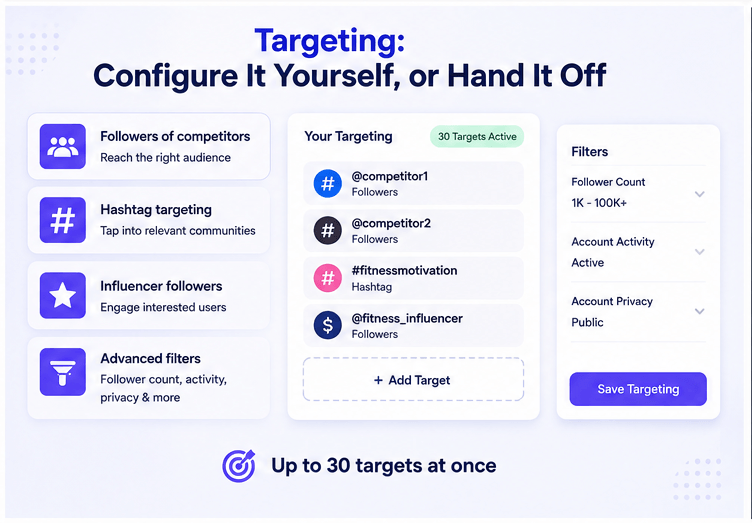
Jumpgram's targeting happens entirely behind the scenes — its team and algorithm decide who gets engaged, based on interests, location, and engagement patterns. You get less visibility into the mechanics, which some people genuinely prefer. It's one less thing to manage.
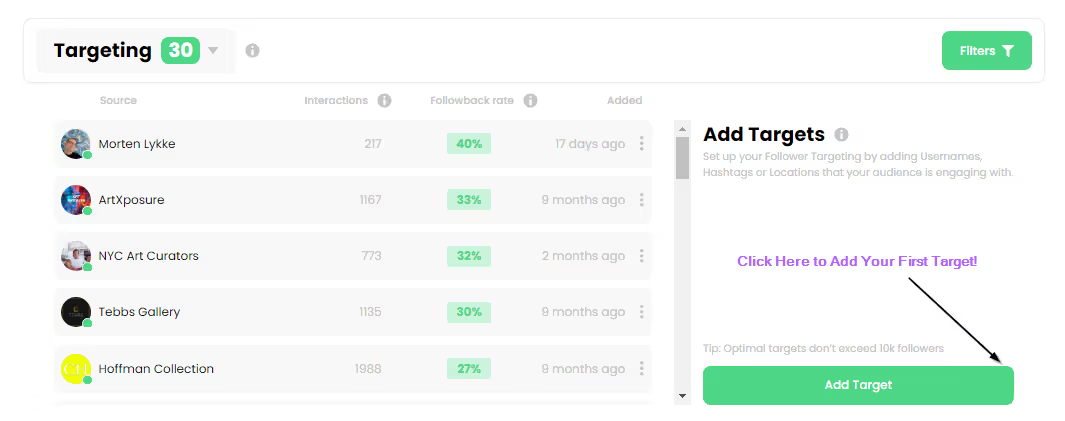
Kicksta puts that control in your hands. Target followers of competitors, relevant influencers, or hashtag communities, then stack filters for follower count, activity level, and account privacy — up to 30 targets (10 on the Growth plan) running at once. If you're not sure where to start, built-in recommendations pull from historical campaign data across major niches. Open the dashboard and you can see exactly how the system finds and engages accounts in real time, rather than trusting a black box.
This matters most for accounts with a specific or unusual niche. A generic wellness brand and a niche vintage-camera reseller need very different targeting strategies, and a system you can configure and adjust yourself lets you react quickly if a target isn't performing — swap it out the same day, rather than waiting on a scheduled check-in with a team to revisit strategy.
The Full Sequence After a Follow
Jumpgram's strength is direct human interaction — real outreach, real DMs, and on higher plans, ad management and content strategy layered on top. That's a broader service, but it isn't built around a layered engagement sequence the way a dedicated growth platform is.
Kicksta wraps a sequence around every single follow. A targeted account gets a story view first, days before any decision about following happens. If they follow back, their recent posts get a like to reinforce the connection, and they land in your Close Friends list — so the next Story you post shows up with that green ring people associate with closer connections, not just another post in the feed. Only after three or four days, and only if they actually followed back, does a Welcome DM go out. From the other side, it doesn't read like a bot fired off a script the second they hit follow — it reads like someone who's been quietly around for a few days finally saying hello.
There's a practical reason the sequence is staged this way rather than compressed. A DM that arrives the instant someone follows back reads as automated, even if a human wrote the copy. Spacing it out, and gating it behind an actual follow-back rather than blasting it to everyone who was targeted, keeps the whole interaction feeling closer to how two real accounts would naturally get to know each other over a few days — which is also part of why it holds up better under Instagram's own scrutiny of automated behavior.
{{blog-cta-section}}
Safety: Same Goal, Different Approach
Instagram's own guidelines explicitly prohibit inauthentic and automated behavior, and the accounts that run into trouble are usually the ones whose activity patterns don't hold up under scrutiny — regardless of which service they're using.
Kicksta manages that risk through infrastructure: real devices, dedicated proxies, randomized batches, a warm-up period, and adaptive cooldowns that kick in automatically. Jumpgram manages it through human oversight and a deliberately conservative pace, since a person is making each engagement decision. Both steer clear of the bot-farm and bulk-purchase tactics that create the most obvious account risk. Neither is bulletproof, but neither leans on the tactics Instagram actively enforces against.
Worth noting: no growth service, automated or human-run, can offer a guarantee against every possible account restriction. Instagram's enforcement systems change over time, and any platform claiming zero risk isn't being fully straight with you. What actually separates the reasonable options from the risky ones is whether the underlying method — real accounts, real engagement, reasonable pacing — holds up to that scrutiny in the first place, which both Kicksta and Jumpgram's models genuinely do.
The Math: Kicksta Costs Less at Every Tier
The Math: Kicksta Costs Less at Every Tier
| Kicksta | Jumpgram | |
| Entry Plan | $69/month (Growth) |
$99/month (Starter Pack) |
| Mid Plan | — | $199/month (Go Pro Pack) |
| Top Plan | $129/month (Advanced) |
$299/month (Guru Pack) |
| Annual Discount | Up to 43% off | Not specified |
| Free Trial | 7 days | 1 week |
| Results Guarantee | Yes, or trial extended |
Minimum guarantee with refund |
Part of Jumpgram's higher pricing reflects the ad management and content strategy bundled into its top plans — services that sit outside growth automation entirely, so this isn't a perfectly apples-to-apples comparison. But if follower growth specifically is what you're paying for, Kicksta gives you more for less at every level.
It's also worth thinking about total cost over a year, not just the monthly sticker price. With Kicksta's annual discount applied, the gap between the two widens even further — which matters if you're budgeting growth spend across multiple accounts or clients rather than a single personal profile.
Results: What the Numbers Actually Mean
Kicksta targets a 10%+ follow-back rate, with guaranteed growth: if you don’t see growth in your first 7 days, Kicksta extends your trial.
Jumpgram guarantees minimums starting at 700 followers a month on its Starter Pack, up to a ceiling of 5,000 on the Guru Pack, though results depend heavily on content quality and how much bandwidth the team working your account actually has that month.
Either way, the number that matters more is engagement rate, not raw follower count. A thousand new followers who never open your Reels aren't worth much. What happens after someone follows you comes down to your content — Instagram increasingly weighs Instagram's Originality Score before deciding how far anything you post actually travels, no matter which service brought the follower in.
This is worth sitting with for a second, because it's easy to lose sight of when comparing two growth services side by side: no platform, automated or human-run, can make a mediocre content strategy perform well. Growth tools widen the top of the funnel — more relevant people seeing your profile, more chances to follow. What they can't do is make someone stick around, engage, or convert if the content itself doesn't hold up once they get there.
Getting Started
Kicksta is self-serve from the first click: sign up, pick a proxy location, connect your account, set your targeting, and the system takes over. Log in the next morning and the dashboard already has activity to show you — follow-backs, story views, a running tally — instead of a blank screen waiting for something to happen. The Kicksta blog also runs weekly guides on Instagram marketing if you want to dig into strategy on your own time.
Jumpgram starts with a conversation instead. You talk through goals and niche with their team, and they build a plan around it. That adds a bit of friction before anything starts moving, but it also means an actual person has looked at your specific situation before deciding what to do — which matters more to some people than getting started fast.
What Switching Actually Looks Like
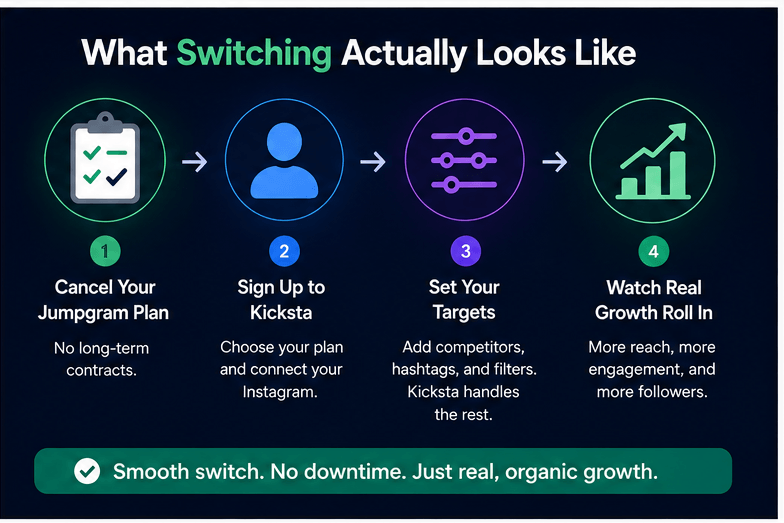
If you're already on Jumpgram and thinking about moving over, there's no real technical migration involved — you're not exporting data from one platform into another. You'd simply cancel or let your current plan run out, then set up Kicksta on your own timeline. There's no reason the two have to overlap; most people either finish out a billing cycle on one before starting the other, or run a short trial period side by side to compare results directly on the same account before fully committing.
One thing worth watching if you do run any kind of side-by-side comparison: don't stack aggressive manual activity on top of what either service is already doing. Both platforms are built to keep total activity within a safe range on their own — adding your own manual follow sprees on top defeats the purpose of either service's pacing logic.
Frequently Asked Questions
Is Kicksta safe to use with Jumpgram at the same time? Not recommended. Running two engagement-based growth services simultaneously on the same account stacks activity in a way neither platform's safety systems are designed to account for. If you're switching, it's cleaner to finish one before starting the other.
Does Kicksta work for business or creator accounts specifically? Yes — Kicksta works across personal, creator, and business account types, and the targeting system doesn't require a specific account type to function.
How long before I see real results? Kicksta's warm-up period means the first few days ease into full activity rather than starting at maximum volume immediately. Most users start seeing meaningful follow-back activity within the first week, which lines up with the 7-day trial window: if you don’t see growth in your first 7 days, Kicksta extends your trial.
Can I pause or adjust targeting after I've started? Yes, and this is one of the more practical advantages of a self-serve dashboard over a periodically-reviewed human account: you can adjust targets, filters, or pause activity entirely whenever you want, without waiting for a scheduled check-in.
Which One Is Actually Right for You
Two questions do most of the work here.
Do you want to configure something once and let it run, or talk to a person and hand the whole thing off? If it's the first, Kicksta's dashboard-and-automation model fits. If it's the second, Jumpgram's consultative, human-run approach is built exactly for that.
Does your content touch anything sensitive enough that a human judgment call on outreach timing matters? If yes, that's the one area where Jumpgram's team genuinely has an edge worth paying for. If your content is fairly ordinary — a brand, a creator, a business account without that kind of risk — Kicksta's automation covers the same ground for less money and more visibility.
For most people comparing the two, it comes down to control and cost: Kicksta offers more of both. Jumpgram offers a genuine human safety net in exchange for a higher price and less day-to-day visibility. Neither choice is wrong — it depends which trade-off actually matches how you want to run your account.
If you're leaning toward trying it yourself, Kicksta's 7-day free trial is the lowest-risk way to find out — growth is guaranteed within that window or Kicksta extends your trial, and you can start your cancellation from Settings in your Kicksta dashboard if it's not the right fit.