What Are You Actually Buying When You Buy Followers From Poprey?
.jpg)
Somewhere in your research into Instagram growth options, you've probably come across Poprey — the pricing is the first thing most people notice. Likes from $2.60, followers from around $1.90, a free trial of 25 likes with no signup required. It's an easy service to try because there's almost no barrier to trying it.
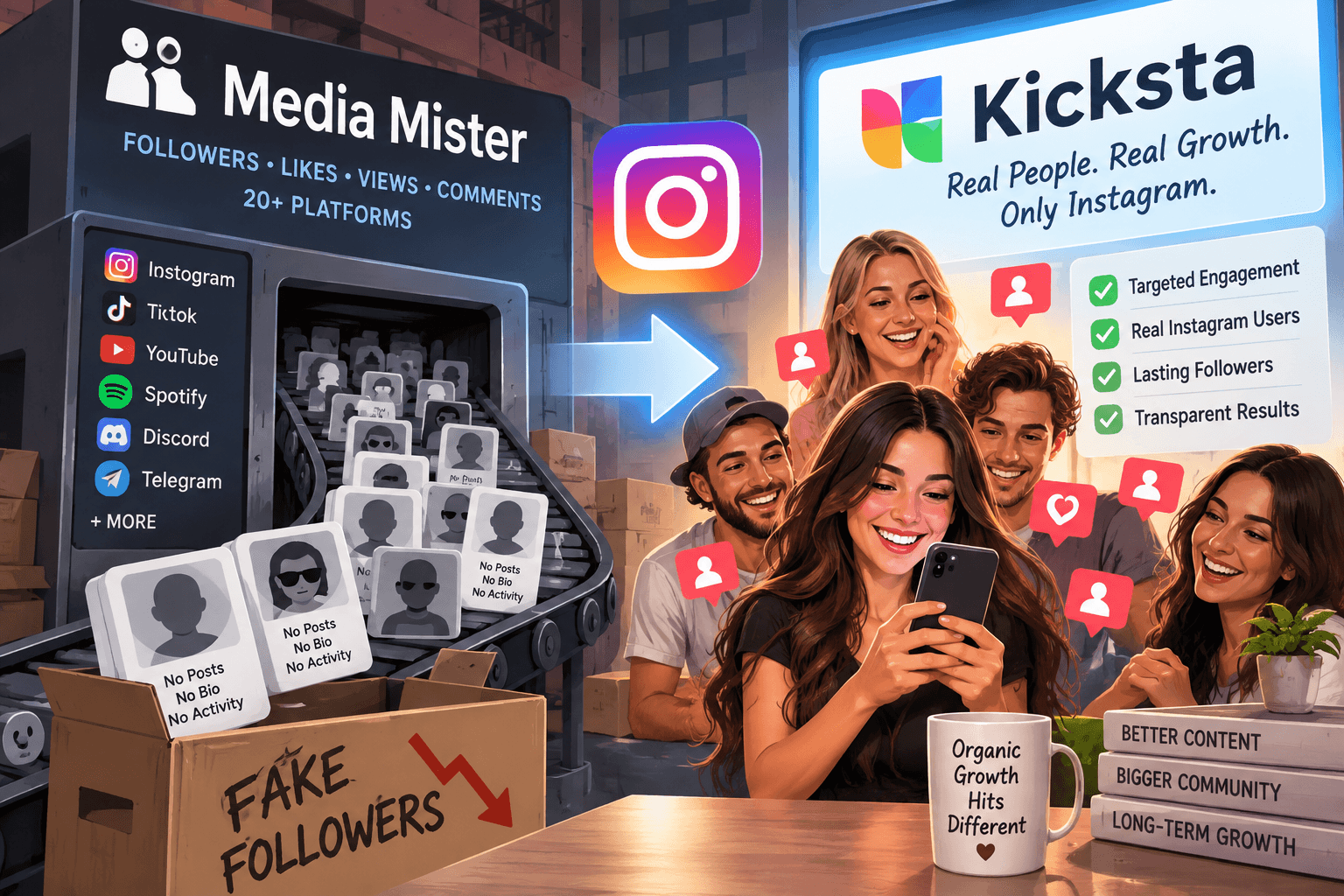
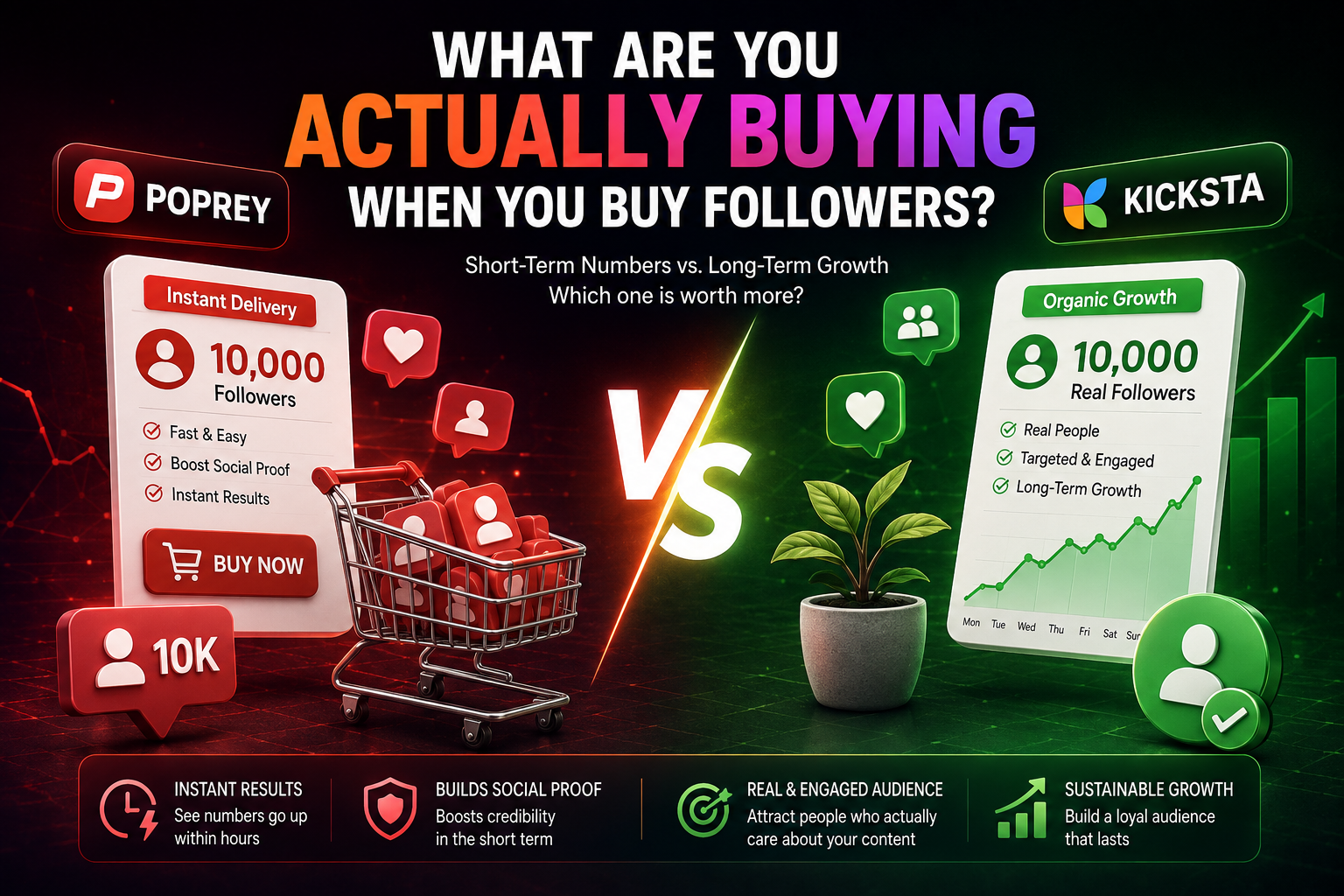
Kicksta shows up in a lot of the same searches, and on the surface the two look like they're competing for the same customer. They're not, really. One sells you a specific quantity of engagement. The other builds you an audience over time. Both are legitimate businesses that do what they say — the question worth working through is which one actually gets you something worth having a year from now.
What a 25-Like Free Trial Actually Tells You
Poprey's free trial is 25 likes, no signup, no commitment — you can literally see the product before spending a cent. That's possible because what Poprey sells is a unit: a fixed, discrete thing that either shows up on your post or doesn't. Trying it costs Poprey almost nothing and tells you almost everything about what you're buying.
Kicksta's free trial works on a different logic entirely, because there's no discrete unit to sample — you're trying a process, not a product. Seven days is roughly how long it takes to see whether targeted engagement is actually converting into real follow-backs for your specific niche, which is why the trial comes with guaranteed growth instead of a fixed sample size: if you don’t see growth in your first 7 days, Kicksta extends your trial.
What Poprey Is Actually Selling
Poprey has been operating since 2017 and says it's trusted by over 1.2 million users. The mechanics are straightforward: pick a service — followers, likes, views, comments — across Instagram, YouTube, or TikTok, enter your username or post link, pay, and the engagement lands, usually within a few hours. You can choose instant delivery or a gradual option that spreads the activity out to look less like a sudden spike.
Poprey is upfront that its own framing is about boosting a specific piece of content, not building an audience — its positioning centers on "post-level engagement," giving a launch or a new format an early signal boost. Poprey's own materials note that this "works best when it supports existing content rather than trying to replace it" — a fair thing to say, and also the honest ceiling of what post-level delivery can do.
Setting Up Kicksta's Targeting
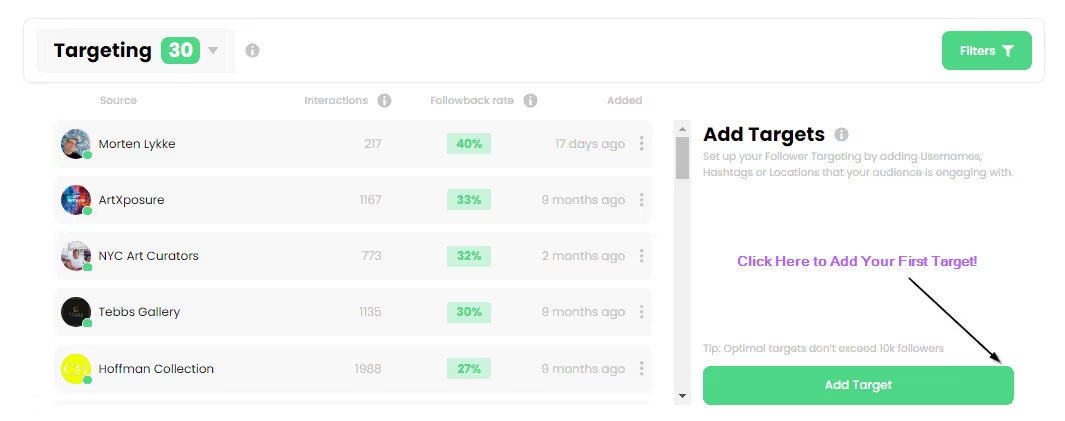
Kicksta starts from the opposite direction: instead of delivering a number, it builds a targeting profile aimed at people who are actually likely to care about your content, then lets them decide whether to follow. You point it at competitor accounts whose audiences resemble your ideal one, relevant influencers in your space, and hashtag communities your future followers already use, then narrow with filters on follower count, follow ratio, posting activity, and account privacy. Up to 30 targets (10 on the Growth plan) can run simultaneously, and new accounts aren't guessing blind — Kicksta draws on performance data from similar niches to suggest targets that have already worked.
The whole thing runs from real physical devices with dedicated proxies, chosen from 60+ countries and dozens of major U.S. cities, so activity looks like a consistent person logging in from one place rather than a script running somewhere else. After a warm-up period, the system scales to about 400 actions a day — roughly 12,000 a month — aimed at a follow-back rate of 10% or higher.
None of that requires you to actually do anything once it's set up. A fitness coach targeting followers of three regional competitor gyms and a handful of nutrition hashtags doesn't need to check in daily to see whether the targeting is working — the dashboard shows it directly, target by target, and if one competitor's audience turns out to convert at half the rate of another, that's visible in the data rather than something you'd have to guess at from a slowly climbing follower count.
The Sequence After Someone Follows Back
This is where the two models diverge the most, and it's worth walking through slowly because the difference isn't really about the follow itself — it's about everything that happens around it.
Before anyone has followed you back, Kicksta has already had their stories viewed by your account, which is a quiet, low-pressure touchpoint that puts your profile on their radar without asking anything of them yet. Once they do follow, Like After Follow engages with a couple of their recent posts to make the connection feel reciprocal instead of one-sided, and they're added to your Close Friends list — which matters more than it sounds like it should, because people notice the green ring and tend to prioritize checking stories from accounts they associate with it. A welcome DM goes out three to four days later, and only to people who actually followed back, so by the time it lands, the person receiving it has already seen your account show up a few times. It reads like an account that noticed them, not a script that fired the second they tapped follow.
Poprey's engagement, by contrast, is a single transaction. The number changes, and that's the extent of the relationship — there's no mechanism for it to develop further, because nothing about the delivery is designed to build one.
{{blog-cta-section}}
Numbers vs. a Relationship
Instagram's algorithm weighs engagement rate — what share of your followers actually do something with your content — more heavily than raw follower count. A follower who arrived through Poprey's delivery had no independent reason to care about your niche before showing up; Poprey states these are real accounts, and that claim is plausible, but "real" and "interested in your content" aren't the same thing. A follower who arrived through Kicksta's targeting was, at minimum, already engaging with hashtags and accounts adjacent to your niche before your profile ever crossed their path.
That gap compounds in both directions. An audience that actually engages earns wider algorithmic distribution, which brings in more organic followers, which improves engagement further. A follower count that outpaces real engagement does the opposite — it signals to the algorithm that the content isn't resonating, and organic reach narrows in response, regardless of how the followers arrived. It's not a controversial claim; it's the same mechanic that makes spotting fake or disengaged followers a genuinely useful skill for anyone trying to keep their account's numbers meaningful rather than just large. A quick, informal gut-check is to open your own followers list and scroll for thirty seconds: real, niche-relevant followers usually have a posting history, a recognizable bio, and at least some visible activity of their own — accounts that exist only to pad a number tend to look noticeably thin by comparison.
Poprey's targeting gap is worth being specific about, too: there's no way to specify an audience interested in fitness, home design, travel, or any other category. You choose a quantity, and it's delivered without regard to who those accounts actually are. Kicksta's targeting keeps refining itself against real performance data the longer it runs — something a one-time delivery order has no mechanism to do, because there's no ongoing account behavior for it to learn from.
How Each One Handles Instagram's Rules
Poprey's gradual delivery option is a genuine safety feature — spreading engagement out over time is a reasonable way to avoid an obvious spike that looks unnatural. Kicksta approaches the same underlying problem differently: real devices and dedicated proxies keep activity looking like one consistent person, daily actions are distributed in randomized batches instead of uniform patterns, and an adaptive cooldown system automatically dials back follow and unfollow activity — shifting to lower-risk actions like story-viewing — the moment Instagram signals any concern.
Neither approach is a guarantee, and it would be overstating things for either service to claim otherwise — the actual rules are Instagram's own, and they apply no matter which service you're using. What's fair to say is that the two are managing different risk windows: Poprey is managing how a delivered batch looks the moment it arrives, and Kicksta is managing how months of ongoing daily activity look over time. If Instagram's systems flag unusual activity on a Kicksta-managed account, the adaptive cooldown pulls back automatically — pausing follows and unfollows and leaning on lower-risk actions like story views until things settle — without you needing to notice anything was happening in the first place, let alone intervene.
What a Realistic Content Strategy Still Has to Do
It's worth naming a limitation that applies regardless of which service you pick: neither one can make weak content perform. Poprey can hand you a number; Kicksta can hand you an audience willing to look. Neither can make someone save a post that has nothing worth saving, or watch a story that says nothing. The actual case for Kicksta only holds up if there's something on the other end worth that audience's attention — a delivered number never had that requirement to begin with, since it was never expected to be impressed.
Where Poprey's Low Price Actually Wins
There's a real, specific reader who's better served by Poprey than by Kicksta, and it's worth naming honestly instead of glossing over it: someone testing a new content format who wants a cheap, fast signal on whether an early engagement boost helps a post gain traction, or someone launching a specific piece of content and wanting some initial social proof before organic reach kicks in. For that narrow job — not an ongoing growth strategy, a single test or a single push — Poprey's price and the no-signup trial make it easy to try with almost nothing at stake.
Where it runs out of runway is the moment that specific job is done and you're left asking what the account looks like going forward, which is a different question than the one Poprey was built to answer. Poprey isn't the only service built around instant, on-demand delivery, either — our Blastup vs. Kicksta comparison walks through the same trade-off against a service that leans even harder into speed over targeting.
The Real Cost Once You Add It Up
Poprey's pricing is entirely per-unit: Instagram likes start at $2.60 for 200 and scale to $109 for 20,000+; followers start around $1.90 for small packages; a 25-like trial is free with no signup, and auto-like subscriptions are available if you want repeat delivery without reordering manually each time.
Kicksta runs two monthly plans. The Growth Plan is $69/month ($39/month billed annually) and lets you target up to 10 sources. The Advanced Plan is $129/month ($79/month annually), lets you target up to 30, and adds Welcome DM, Close Friends Adder, and the Gender filter. Both plans include targeting, the post-follow engagement sequence, and Allow list and Block list controls. Both include a 7-day free trial and guaranteed growth: if you don’t see growth in your first 7 days, Kicksta extends your trial.
Poprey vs. Kicksta: The Real Cost Once You Add It Up
| Poprey | Kicksta Growth | Kicksta Advanced | |
|---|---|---|---|
| Pricing model | Per-order, pay as you go | $69/mo ($39/mo annual) | $129/mo ($79/mo annual) |
| What you get | A fixed quantity per order | Up to 10 sources, ongoing | Up to 30 sources, ongoing |
| Targeting | None | Niche, competitor, and hashtag targeting | Same, at higher volume |
| Free trial | 25 likes, no signup | 7 days, guaranteed growth or trial extended | 7 days, guaranteed growth or trial extended |
| Platforms | Instagram, YouTube, TikTok | Instagram only | Instagram only |
The comparison that actually matters isn't per-unit price — it's what a unit is worth in practice. A cheap like on a post that nobody who cares about your niche ever sees is still a cheap like. A follower who's already interested in what you post is worth meaningfully more than the subscription cost implies, because that person keeps generating engagement long after the initial follow.
What Changes in the First Few Days
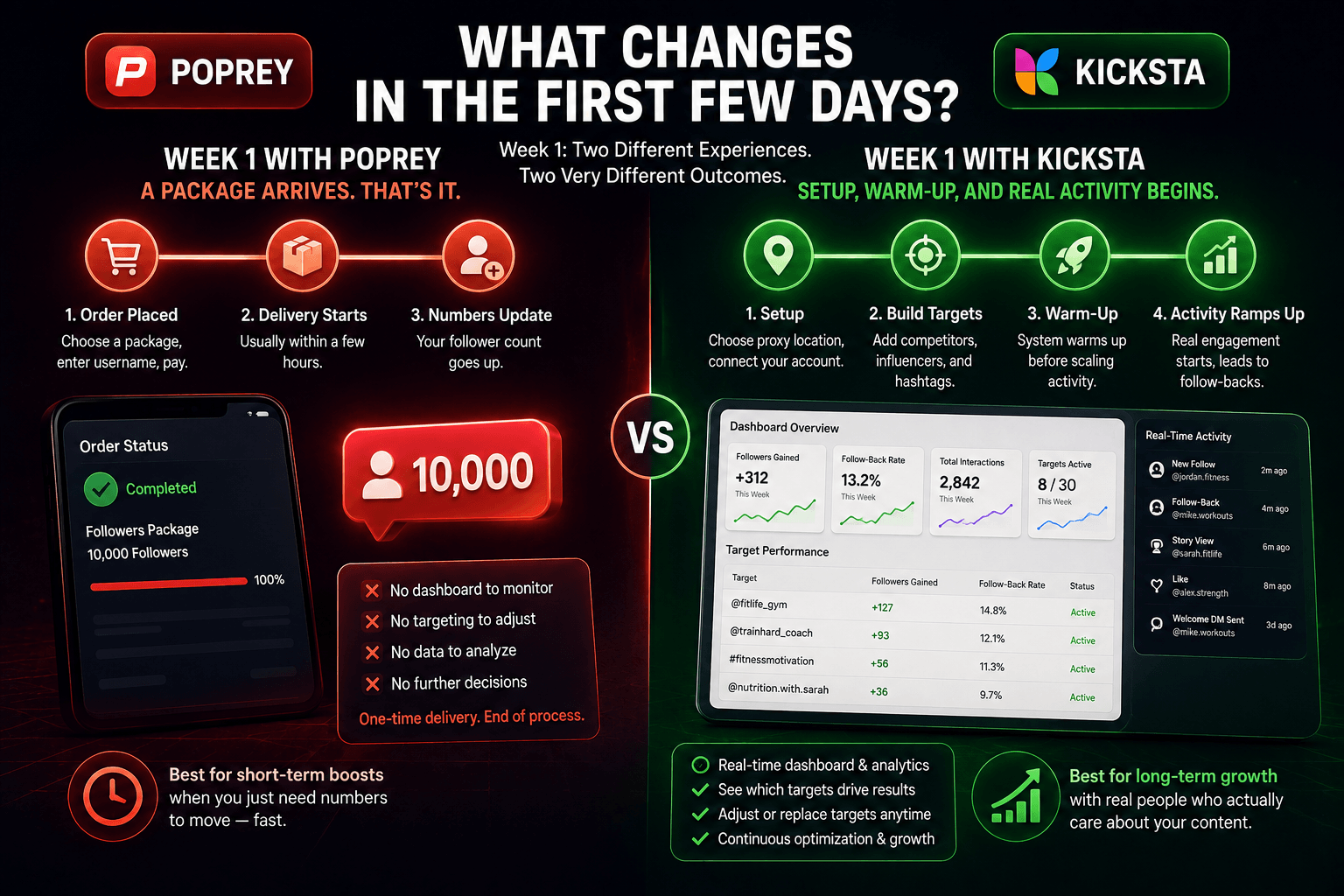
With Poprey, week one looks like whatever you ordered: a package arrives, the number changes, and that's largely the extent of it unless you place another order. There's no dashboard to check back on beyond an order-status page, and no further decisions to make once payment clears — which is either a relief or a limitation depending on how hands-on you want to be.
With Kicksta, week one is mostly setup and then watching the system start working — choosing a proxy location, connecting your account, and building your first targets, followed by a short warm-up period before activity ramps to full scale. The dashboard turns into something you check periodically rather than manage daily: every follow, follow-back, and interaction logged in real time, with a complete record of which target produced which follower if you want to see what's actually converting. If a target isn't performing, you can swap it out and let the system redirect toward something that is — a level of course-correction a one-time delivery order simply doesn't offer, since there's nothing left to adjust once the order is placed.
Common Questions About Poprey
Is Poprey legit? Poprey has operated since 2017 and states it serves over 1.2 million users, with a free trial and multiple payment options. It's a real, functioning service — the relevant question isn't whether it delivers what it promises, but whether what it promises (a quantity) is what you actually need.
Does Poprey's gradual delivery actually reduce risk? Spacing engagement out over time is a reasonable safety measure compared to an instant spike, and it's a genuine feature. It doesn't change the fact that the engagement itself has no connection to your niche or content.
What do Poprey reviews generally say? Feedback tends to split along predictable lines — people using it for a specific, one-time boost tend to report it working as described, while people hoping it would function as an ongoing growth engine tend to be disappointed once the numbers plateau after delivery.
Is there a subscription with Poprey? Only if you opt into the auto-like subscription option; otherwise every purchase stands alone, with no recurring charge.
What if I want an audience that keeps growing and actually engages? That's the specific problem Kicksta is built around — ongoing targeted engagement instead of a one-time delivery, aimed at people already interested in your niche. (If a purchase-based delivery service is closer to what you're weighing Poprey against, our iDigic Alternative breakdown covers that same kind of comparison from a different angle.)
Two Questions Worth Asking Yourself
Do you need a quick, low-cost engagement bump for one specific post, test, or launch — and nothing more than that? If so, Poprey's price and its no-signup trial make it a reasonable, low-risk way to get exactly that.
Are you trying to build something on Instagram that's still growing, still engaged, and still earning organic reach a year from now? For most people who land on a "Poprey alternative" search instead of just buying the cheapest package they can find, that's the actual question underneath the search — and it's the one Kicksta's model is built to answer.
The Real Trade-Off
Poprey isn't a bad service — it's a narrow one, built to do a specific, transactional job well and cheaply. If that's genuinely all you need, it does it. What it can't do is turn into a growing, engaged audience after the order is delivered, because nothing about the model is designed to develop past the initial transaction.
Follower count is a genuinely misleading vanity metric when it isn't backed by anything real underneath it, and that's the core of what separates these two services. Kicksta costs more, takes longer to show results, and asks you to trust a process instead of a number you can see on day one — but the number it eventually produces is made of people who chose to be there. For anyone thinking past the next campaign, that's the number worth building toward.